EMS vs Microcurrent for Facial Devices: Mechanisms, Specifications and Product Positioning
Two facial devices can promise the same “toning” experience while delivering very different electrical outputs. A beauty brand comparing EMS vs microcurrent therefore faces more than a naming problem. If a product team approves a platform on sensation, appearance or a supplier’s headline number, it may discover later that the manual, evidence and intended market do not support the launch story.
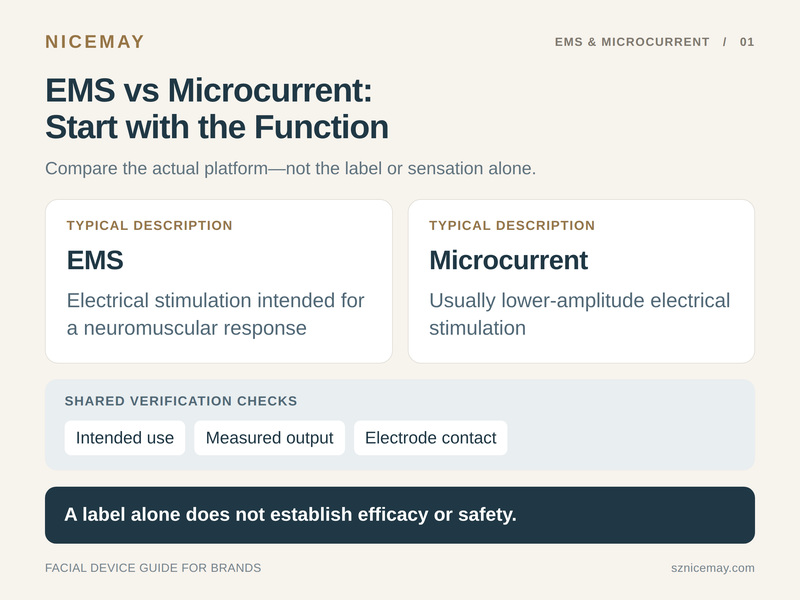
Quick answer: EMS usually describes electrical stimulation intended to produce a neuromuscular response, while microcurrent usually describes lower-amplitude electrical stimulation. Neither label establishes cosmetic efficacy or safety. Brands should compare intended use, measured waveform and output, electrode contact, finished-device evidence and manufacturing controls—not sensation or terminology alone. 1 2
At Nicemay, we approach this decision as a product-development question. The aim is not to declare one technology universally better, but to select an electrical-stimulation platform that fits a clear consumer proposition and can be specified, evaluated and reproduced. This guide is for beauty brands, importers, distributors and private-label teams; it is not a personal treatment protocol or advice about managing a medical condition.
Summary: EMS and microcurrent overlap in commercial language, so a meaningful comparison starts with what the finished device actually delivers. The strongest sourcing brief separates mechanism, technical performance, user experience and cosmetic claims. Facial studies provide useful examples, but their results belong to the devices and protocols studied. Buyers should define the electrical output and contact system before choosing a format, then assess evidence, permitted use areas and destination-market requirements. A focused product with clear instructions and repeatable manufacturing may be a better commercial fit than a more intense or more complicated platform.
What is the difference between EMS and microcurrent in a facial device?
EMS stands for electrical muscle stimulation. In neuromuscular electrical stimulation, or NMES, electrical pulses can activate motor nerve fibres and produce muscle contraction. Sensory fibres may also respond. The term therefore describes a stimulation intention and mechanism, not a promise of facial lifting. A product marketed as EMS still needs model-specific output and appropriate verification of its intended response. 1
Microcurrent generally refers to low-amplitude electrical stimulation, often discussed in microampere ranges and as sub-sensory stimulation. However, published protocols and market terminology are not fully standardised. A review centred on exercise applications illustrates considerable variation in current, waveform and timing. Its terminology is useful context, but not a universal classification rule for every facial beauty device. 2
The practical distinction is not “EMS works on muscle; microcurrent works only on skin.” That statement oversimplifies a parameter-dependent response. Nor should buyers assume that a microcurrent device is simply an EMS device with its intensity turned down. Define the intended function, complete signal and contact arrangement before assigning a technical description. 1 2
| Comparison point | EMS / NMES-oriented platform | Microcurrent-oriented platform |
|---|---|---|
| Typical description | Electrical stimulation intended to create a neuromuscular response | Lower-amplitude electrical stimulation |
| What must be verified | Output and response appropriate to the intended use | Actual low-level output under stated conditions |
| What sensation establishes | User feedback, not proof of cosmetic efficacy | User feedback, not proof of technology identity |
| Evidence needed | Finished-device evidence for the proposed outcome | Finished-device evidence for the proposed outcome |
| Useful sourcing question | What response is intended and how is it controlled? | What current is delivered and how is it measured? |
Use this table as a comparison framework, not a legal taxonomy or an efficacy ranking. Our face-toning product platforms show how different handheld formats can be considered for a brand brief. A category label is a starting point for discussion; the controlled specification and intended-use assessment should determine the final description. 13
For a focused explanation of the mode label, read our guide to what EMS means on a facial massager.
How does facial electrical stimulation work—and what does the mechanism not prove?
Why does the electrode interface matter?
Electrical stimulation is delivered through a contact system, not through a technology label. Electrode geometry, placement and the skin–electrode interface influence current delivery and the resulting response. Amplitude, pulse duration, timing and stimulation patterns also matter. Two devices with the same nominal maximum current can therefore differ in use because the rest of the system is different. 1 7
For a brand, this means the treatment head and compatible contact medium belong in the product specification. They should not be treated as decorative accessories. A change in electrode finish, geometry or contact instructions should prompt a review of electrical behaviour and usability. The review should be proportionate to the change and the product’s risk assessment, rather than assumed unnecessary because the circuit board is unchanged. 7 11
Why is a biological explanation not a cosmetic outcome?
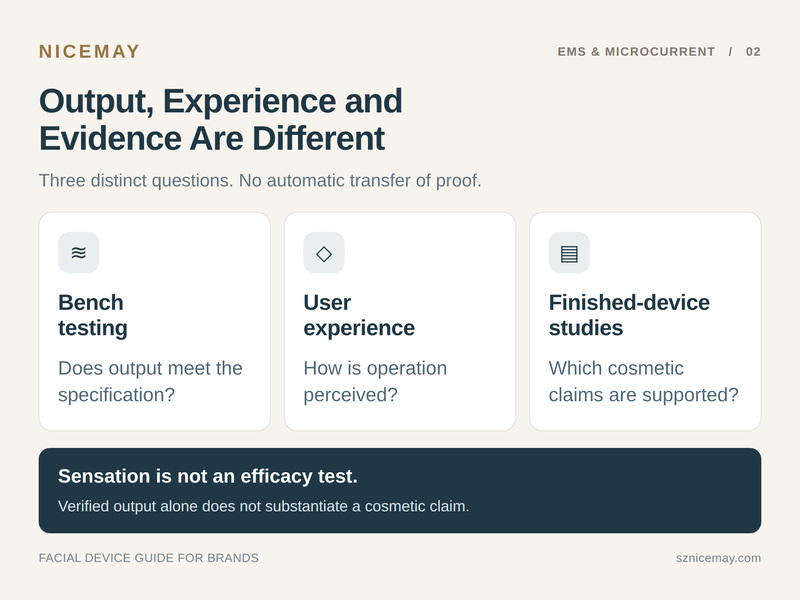
A mechanism can explain why an electrical signal may produce a response. It cannot establish how much a particular cosmetic endpoint will improve, who will notice it or how long it will last. Muscle contraction is an observable response; a sustained change in facial appearance is a separate outcome. An instrument reading, a satisfaction survey and a marketing photograph answer different questions. 1 3
Microcurrent discussions frequently mention adenosine triphosphate, or ATP, which is involved in cellular energy processes. The exercise-focused review discusses proposed cellular mechanisms and traces prominent ATP work to animal skin research. That does not show that a short facial session with a commercial device increases human facial ATP, rebuilds collagen or produces a lasting lift. Avoid turning a laboratory mechanism into a finished-product benefit without matching evidence. 2
The same separation applies to rehabilitation. Evidence about injured tissue, muscle weakness or body training can inform background science, but it does not automatically support cosmetic claims in healthy facial users. If a proposed product story depends on that transfer, revise the story or obtain evidence appropriate to the finished device and intended population. 1 2
Can brands identify the technology from current units or sensation alone?
Microamperes and milliamperes are units of current, not independent technologies. A figure becomes comparable only when the supplier identifies whether it is a peak, an RMS value or an average, and states the waveform, observation window and load. The FDA’s powered muscle stimulator guidance separately requests output characteristics and test conditions, illustrating why an isolated amplitude is insufficient. 7
A short pulse can have a peak value different from its average over a full programme. With some charge-balanced waveforms, a signed average may be close to zero even though individual phases carry current. That does not mean the device delivers no stimulation. We recommend asking for the labelled waveform and measurement definition instead of trying to compare numbers taken from different reporting conventions. 7
Sensation is also an unreliable classifier. Contact conditions, electrode location, pulse characteristics and individual response can affect what a user feels. A noticeable sensation is not proof of a meaningful cosmetic change; an absence of sensation is not proof of a failed device or a particular microcurrent mechanism. Technical output testing and user-experience evaluation should be separate parts of sample review. 1 2
For customer education, avoid messages such as “turn it up until you feel it working.” They can confuse discomfort with performance. A product should have instructions that define permitted settings, intended areas and the response to discomfort. FDA reports of pain, irritation and other adverse effects reinforce the need to evaluate the finished design rather than treat intensity as a positive sales metric. 8
What does the evidence actually support for facial EMS and microcurrent?
There is published human research on facial electrical-stimulation devices, but it does not provide a universal EMS-versus-microcurrent winner. Evaluate what was delivered, which device was studied, who participated and which endpoints were measured. A positive result in one study is useful context, not a licence to copy that result into another brand’s product listing. 3 4 6
What can the 2012 facial NMES trial tell buyers?
Kavanagh and colleagues randomised 108 healthy women to a specific facial NMES device or a no-treatment control for a 12-week study. Blinded ultrasound assessment found changes in the thickness of the zygomaticus major muscle, and users reported improvements in perceived facial firmness, tone and lift. These are distinct objective and subjective findings; the survey answers are not an objective “lifting rate.” 3
Important limitations sit beside those findings. There was no sham-stimulation control, participants knew whether they used the device, and the manufacturer funded professional participation in the study. The authors did not establish that the ultrasound change necessarily represented muscle-fibre hypertrophy. Nor did the study establish collagen rebuilding, fat reduction or a persistent benefit after stopping use. The results belong to that particular device and protocol. 3
Why does the 2024 split-face study need a different interpretation?
A prospective study by Omatsu and colleagues followed 24 healthy women for eight weeks. The right side received a multi-function device routine plus basic skincare, while the left side received basic skincare. The treatment side was not randomised, and the device included other functions alongside electrical stimulation. Some appearance and skin measurements improved, but the design cannot isolate an EMS-only contribution. 4
A 2026 journal correction disclosed that two authors were manufacturer employees and that the manufacturer supplied some devices and measurement equipment. This does not automatically invalidate the findings, but it changes how independence should be described. The study’s surface-volume and elasticity measurements also should not be translated into proof of fat loss or collagen formation. There was no follow-up establishing persistence after stopping the routine. 4 5
Why should buyers trace a review back to the original trial?
A home-beauty-device review placed the 2012 NMES trial within its microcurrent discussion. That is a useful warning about classification: a review heading does not change the original device’s stimulation intention or output. Counting the review and its underlying trial as two independent efficacy studies would also overstate the evidence. 3 6
The sources reviewed here do not establish a high-quality head-to-head comparison between facial EMS and purely low-amplitude, sub-sensory microcurrent. That is not a claim that no other studies exist. It means we should not use this evidence set to say EMS is clinically superior or microcurrent is inherently safer. A proposed product claim still needs its own substantiation review. 2 3 4 6
| Evidence type | What it can inform | What it cannot establish alone |
|---|---|---|
| Mechanism or non-facial research | Plausibility and parameter dependencies | Finished facial-device efficacy |
| 2012 facial NMES trial | Specific short-term muscle and perception findings | Universal lifting or category superiority |
| 2024 multi-function split-face study | Findings for a combined routine | An isolated EMS effect or lasting fat reduction |
| Output bench testing | Whether the unit meets its declared performance | A visible cosmetic outcome |
We recommend an evidence file that links each proposed claim to the tested configuration, population, protocol and endpoint. Record control methods, adverse events and relevant disclosures. If a sentence cannot be connected to that file, make it narrower or leave it out. This keeps a study summary useful to commercial teams without converting uncertainty into a sales promise.
Which specifications make two facial devices meaningfully comparable?
Before comparing price or custom colours, request output data for the exact modes and settings under review. The FDA’s regulated-stimulator guidance illustrates a useful reporting structure: waveform traces, stated load conditions, current and voltage, phase timing, pulse characteristics and electrode information. These fields can inform a technical discussion, but the guidance is not a universal safety specification for cosmetic devices. 7
To turn this comparison into purchasing requirements, use our facial EMS device specification checklist.
What should the electrical-output description include?
Ask whether the output is current-controlled, voltage-controlled or otherwise regulated, and within which operating conditions. Request the relevant amplitudes with their definitions and tolerances, alongside time-labelled waveforms. Clarify pulse repetition, phase duration, burst timing and any carrier frequency separately. A single frequency labelled “EMS” does not identify all these timescales. Battery current and rated input power are not electrode output. 7
Bench loads make output records reproducible, but they are not a complete model of a person’s face. We recommend agreeing a justified load range and any additional contact-change tests needed for the design. Compare devices using the same definitions and conditions; do not translate a resistor test directly into a consumer’s treatment current. 7 9
What else belongs in the comparison file?
Review the electrode material, conductive area, spacing, contact medium and permitted configuration. For a multi-channel design, ask how the channels are controlled and how the intended current paths are documented. The output description should remain consistent with the instructions and accessories; changing the contact system can change the assumptions behind earlier testing. 7 11
We also recommend comparing state behaviour: start-up, intensity changes, mode switching, loss and restoration of contact, programme completion and low-battery operation. The appropriate controls depend on the product’s design and risk analysis. Do not assume every device has a contact sensor, a ramp function or the same protective cutoff simply because a brochure uses “smart” or “safe.” 7
Finally, distinguish engineering validation from production release. A prototype can establish that a function is achievable. A controlled specification, approved components, traceable inspection methods and change management help a factory reproduce it. Our verification and pilot-production process can be discussed against the selected project, rather than treated as a substitute for its specific acceptance evidence.
How should brands match EMS or microcurrent to product positioning?
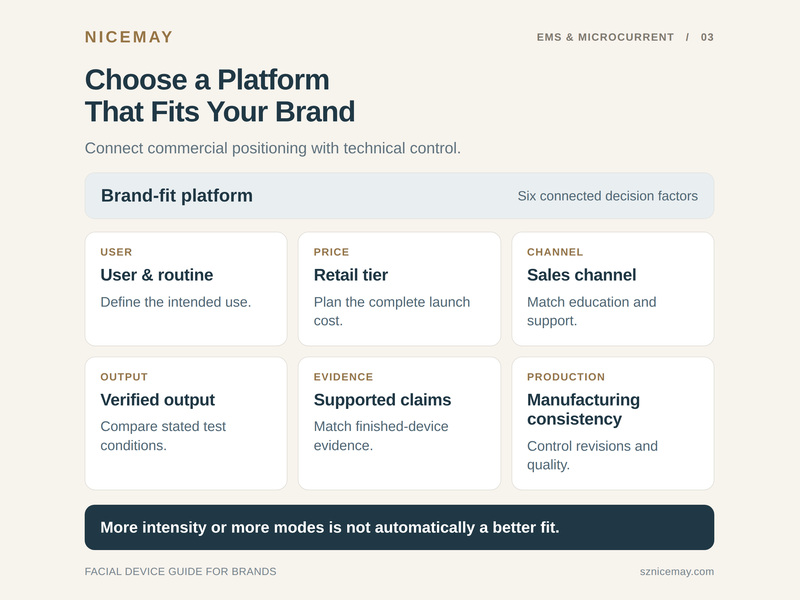
A useful commercial brief starts with the user proposition, not a preferred electrical label. Define the routine you want customers to understand, the target retail tier and the sales channel. Then ask whether the available platform, documentation and evidence can support that proposition. An adjustable stimulation experience is not automatically premium; a low-level experience is not automatically suitable for every user.
The following matrix gives development priorities, not predicted sales performance. Either category may be considered for a positioning row if the actual output, intended use and evidence fit. The commercial decision should include the cost of accessories, instructions, verification, support and foreseeable returns—not merely the purchase price of the device.
| Brand proposition | Platform question | Commercial priority |
|---|---|---|
| Skincare-and-device bundle | Does the contact medium fit the verified electrical routine? | Compatible formulation, replenishment and clear instructions |
| Compact entry-premium tool | Can a focused format deliver a consistent, understandable routine? | Simple controls, packaging and repeatable output |
| DTC facial-toning product | Can the claim be demonstrated without overstatement? | Evidence, onboarding and customer support |
| Amazon-oriented assortment | Can product-page language match the actual SKU and manual? | Clear modes, accessories and traceable quality |
| Distributor or beauty-retail range | Can the same verified configuration be supported across orders? | Local-language documents, service and change control |
How should a skincare bundle differ from a demonstrable hero product?
Consider a skincare brand developing a device-and-gel bundle. We would first define the approved contact medium and the required routine, then evaluate dispensing, glide, clean-up and the clarity of instructions. The fact that a serum feels pleasant is not evidence of electrical compatibility or enhanced ingredient delivery. Those propositions need their own design review and substantiation.
For a DTC hero product, a visible demonstration may attract attention, but its meaning must be explained. A moving treatment head, an indicator light or a muscle response should not be presented as proof that skin structure has changed. We recommend demonstration scripts that distinguish operation from a substantiated cosmetic outcome, and customer-service guidance that does not encourage escalating intensity to chase results.
Why do channel and price tier affect engineering decisions?
A distributor may need a stable configuration that can be trained and supported across languages. A gifting project may favour a simpler interface and fewer explanatory steps. An advanced beauty range may justify more selectable functions, but only if their purpose is clear and the validation budget is realistic. These are product-strategy choices, not reasons to increase electrical output without justification.
We recommend preparing a total launch-cost comparison alongside quotations. Include development changes, test scope, documentation, consumables, spare accessories and after-sales handling. A cheaper platform is not necessarily the lower-risk project, and a premium enclosure does not remedy an undefined waveform. Commercial discipline and technical discipline should guide the same decision.
When does a combined electrical-stimulation platform make sense?
A combined platform can make sense when it contains clearly defined modes that answer different product needs. It does not become technically complete by adding “EMS microcurrent” to the name. If a supplier says one device provides both, ask what changes between the modes: control behaviour, amplitude, pulse shape, timing, intended response or only the label. 1 2 7
Where LED, heat or vibration is added, each function needs its own declared performance and applicable safety assessment. Electrical output testing does not establish the optical dose of an LED channel or the temperature behaviour of a heating mode. Likewise, a human study of the complete routine may support only that combined routine, unless its design isolates the contribution of individual functions. 4 6
For broad technology selection, our RF, microcurrent and EMS platform comparison explains the different development priorities. Within an electrical platform, we recommend mode-by-mode specifications and clear combinations in the manual. Simultaneous operation, sequential operation and independently selected modes should not be described as interchangeable.
A simpler architecture may be preferable when a brand cannot explain the reason for an additional mode or fund its verification. Every selectable state creates another condition to document, test and support. Before making the product multi-function, establish a reason for the extra function and a controlled plan for how it changes the complete device.
What should brands review about safety, use areas and market claims?
Why is “face and neck” not a default permission?
The intended area and electrode/current-path arrangement require specific review. FDA’s powered muscle stimulator guidance recommends warnings against stimulation over the carotid sinus, neck or mouth, and transcerebrally. These warnings should not be dismissed because a product is described as cosmetic. Nor should a category name or a broad product photograph be used as proof that any facial or neck placement is permitted. 7
Document the exact intended configuration against the instructions for use, risk assessment and destination-market pathway. Do not write generic electrode routes into a blog or reuse a body-stimulator routine for the face. FDA reports of shocks, burns, irritation, pain and interference with implanted devices are reasons for design-specific evaluation, not estimates of the incident rate of a Nicemay model. 7 8
How should regulatory documents be interpreted?
IEC 60601-2-10 concerns nerve and muscle stimulators used in physical medicine. Whether it applies to a particular facial beauty device depends on its intended use and relevant market requirements. Its name should not be used as a general “beauty-device certification,” a permission for a body area or evidence of cosmetic efficacy. A standards review and a legal-market assessment answer different questions. 9
For the United States, FDA registration and listing do not denote approval, clearance or authorisation. Verify the actual record relevant to the product and intended use instead of relying on a factory registration number. US intended-use rules also consider objective intent that may be reflected in advertising and other statements, not only the wording on a manual’s cover. 10 12
For Europe, Australia, Japan, South Korea and other destinations, we recommend obtaining a product-specific requirements assessment rather than copying a US document package. Confirm which technical tests, labels, local-language instructions and market responsibilities apply. Cosmetic wording does not itself settle classification, and adding “appearance of” to a claim does not remove the need for appropriate substantiation.
Keep claim language consistent across packaging, the manual, product pages, demonstrations and distributor material. If the intended promise changes, review whether the evidence and pathway still fit. For existing devices within the relevant US 510(k) framework, changes may require a documented assessment and sometimes a new submission; that conclusion cannot be made from the size of a logo change or a general OEM assurance alone. 10 11
How can Nicemay help translate the decision into an OEM/ODM brief?
At Nicemay, we use the product brief to connect commercial intent with configuration choices. Share your target customer, markets, sales channel, retail positioning and proposed routine before selecting a format. Our platform range can support discussion of compact rollers, curved-head massagers and multi-function concepts. The next step is to determine which exact configuration, evidence and development scope the project needs. 13
For example, the MR-2622 roller format and the MR-2368 handheld platform present different physical and user-interface directions. Their public technical sheets are useful starting documents, not complete substitutes for load-specific waveforms, final instructions or the target-market assessment. We confirm the relevant technical description against the agreed project file rather than infer it from a product name. 14 15
Private-label work can begin with branding, packaging and language requirements for an agreed platform. A deeper OEM or ODM project may also need a review of housing, electrodes, interface, firmware or function configuration. Our design and engineering services provide an entry point for that discussion. The scope, validation requirements and commercial terms should be confirmed for the specific project, not promised universally.
Before sample approval, we recommend recording the controlled specification, accessories, claim boundaries and inspection plan. Before bulk release, confirm that production units match the approved revision and that deviations are managed. Our mass-production preparation should be considered alongside traceability and change-control requirements, not as evidence that an unreviewed cosmetic claim has been validated.
What should brands remember before choosing a platform?
Bottom line: The better facial device is not the one with the stronger sensation or more impressive label. It is the platform whose intended use, measured output, evidence, user instructions and repeatable manufacturing fit a clear, supportable brand proposition.
If you are planning a facial-device collection, share your OEM/ODM brief with us. Include the target market, channel, retail tier, proposed claims and preferred format. At Nicemay, we can discuss the platform and next verification steps without treating a technology label as a finished specification.
What else do buyers ask about EMS and microcurrent?
Are EMS and microcurrent the same technology?
They are not interchangeable specifications. EMS usually describes a neuromuscular-stimulation intention; microcurrent usually describes lower-amplitude stimulation. Commercial names can overlap, so compare the actual waveform, output, contact system and intended response before classifying a device. Do not decide from its product name alone. 1 2 6
Is EMS proven to be better than microcurrent for facial lifting?
The reviewed evidence does not establish that conclusion. Facial NMES research concerns particular devices and protocols, while a multi-function study cannot isolate every contribution. These sources are not a robust head-to-head comparison of the two categories. Claims should match the finished device, not a general technology ranking. 3 4 6
Does stronger tingling mean a more effective device?
No. Sensation depends on several electrical and contact factors and does not measure cosmetic efficacy. Discomfort should not be used as a performance target. Product instructions and support material should explain appropriate operation and responses to adverse sensations for that particular model. 1 8
Can an OEM device combine EMS and microcurrent modes?
A project may use differentiated electrical modes if they are technically defined and appropriately verified. Document what changes between modes, their permitted configurations and the relevant evidence. A combined name without mode-specific output data is not a complete technical specification. 7 11
What should a brand request instead of a maximum microamp number?
Request the measurement definition, waveform, load, timing, tolerances and electrode conditions, together with the exact model and revision. Include control and contact-change behaviour appropriate to the design. These records make a declared output auditable; they do not replace evidence for a cosmetic claim. 7
Does FDA registration establish that a facial device is cleared?
No. Registration and listing do not denote FDA approval, clearance or authorisation. Check the specific regulatory evidence relevant to the final product and intended use. A facility number, supplier certificate or another model’s record does not establish the status of the device being sourced. 12
Список литературы
[1] Neuromuscular Electrical Stimulation for Skeletal Muscle Function
Return to text
[2] Physiological effects of microcurrent and its application for maximising acute responses and chronic adaptations to exercise
Return to text
[3] Use of a neuromuscular electrical stimulation device for facial muscle toning: a randomized, controlled trial
Return to text
[4] Neuromuscular electrical stimulation for facial wrinkles and sagging: The 8-week prospective, split-face, controlled trial in Asians
Return to text
[5] Correction to “Neuromuscular Electrical Stimulation for Facial Wrinkles and Sagging: The 8-Week Prospective, Split-Face, Controlled Trial in Asians”
Return to text
[6] Development of Home Beauty Devices for Facial Rejuvenation: Establishment of Efficacy Evaluation System
Return to text
[7] FDA Guidance Document for Powered Muscle Stimulator 510(k)s — Guidance for Industry, FDA Reviewers/Staff and Compliance, June 9, 1999
Return to text
[8] FDA Electronic Muscle Stimulators — Consumer Information
Return to text
[9] IEC 60601-2-10:2012+AMD1:2016+AMD2:2023 CSV — Edition 2.2, official catalogue and public preview of the same standard
Return to text
[10] 21 CFR 801.4 — Meaning of intended uses, FDA regulation on eCFR
Return to text
[11] FDA Deciding When to Submit a 510(k) for a Change to an Existing Device — Final guidance, October 2017
Return to text
[12] FDA Important Reminders about Registration and Listing
Return to text
[13] Nicemay Face Lifting Device Manufacturer: Product Platforms and OEM/ODM Options
Return to text
[14] Nicemay MR-2622 Technical Specification, July 2026
Return to text
[15] Nicemay MR-2368 Technical Specification, July 2026
Return to text