Цвета и преимущества светотерапии с использованием светодиодных ламп: полное руководство
Different LED colors promise different skin benefits. Confusing those promises can leave buyers with the wrong device and brands with claims they cannot support.
LED light therapy uses selected wavelengths to target different skin concerns. Research supports red and near-infrared light for skin rejuvenation, while blue and blue-red light have evidence for acne. Benefits depend on the device, dose, and treatment plan.
I approach LED selection from a beauty device manufacturing perspective. In this guide, I explain what the colors mean, where the evidence is strongest, and what I check before choosing a home-use product.
What is LED light therapy, and how does it work?
A glowing mask makes light therapy look simple. I find the useful explanation starts with the light it delivers, not its appearance.
LED light therapy exposes skin to selected light wavelengths. Some protocols seek to influence biological activity through photobiomodulation. Results depend on wavelength, delivered energy, treatment conditions, and the skin concern being studied.
I start with wavelength, not the color button.
An LED is a light-emitting diode. Its output has a wavelength distribution, often described by a peak wavelength in nanometers (nm). A label such as “red mode” is a starting point. It doesn’t describe the full output.
I also separate LED skincare devices from UV tanning equipment, intense pulsed light systems, and lasers. These categories can deliver different spectra and energy patterns. Evidence for one category does not automatically support another.
Research on red and near-infrared light includes controlled studies of facial skin rejuvenation. Blue and blue-red light have also been studied for acne.[1][2] I use those studies to understand the technology. I do not treat them as proof that every consumer mask performs the same way.
I keep the complete treatment in view.
A useful LED specification tells me what light reaches the skin and how the user receives it. A mask, panel, and handheld device can differ in coverage, distance, and exposure time. A handheld tool may require the user to move it across several areas. A mask may expose several facial areas at once, but its fit still affects light delivery.
For a brand, these differences influence instructions, sample evaluation, and the evidence needed for product claims. I would define the intended use before deciding which format belongs in the range.
If the wider product brief also includes electrical facial technologies, I would use our RF, microcurrent, and EMS selection guide to compare the underlying technologies. Similar cosmetic positioning does not make their operating principles interchangeable.
What do the different LED light therapy colors mean?
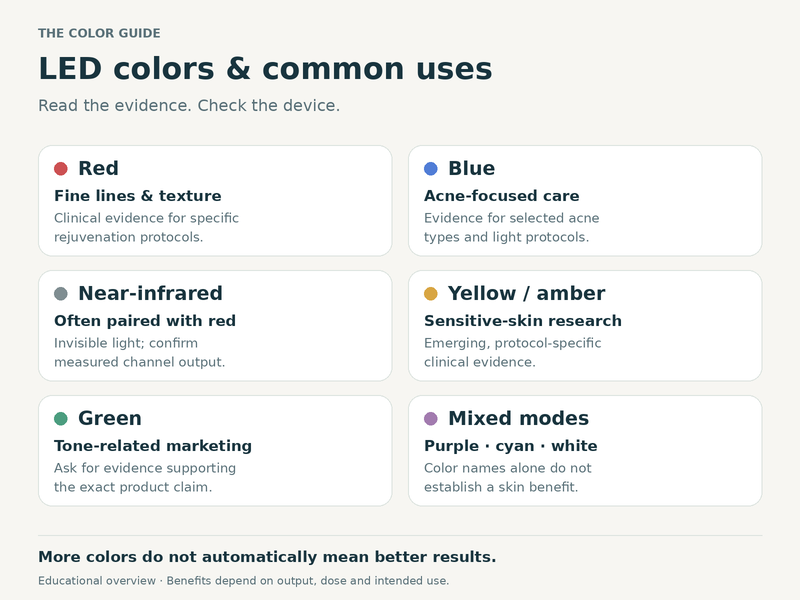
A seven-color chart can suggest seven equally established treatments. I would read each color as a question about spectrum, intended use, and evidence.
Red is commonly associated with skin rejuvenation, and blue with acne-focused treatment. Yellow and green have more specific or developing evidence. Purple, cyan, and white may describe mixed outputs. Near-infrared is invisible and needs separate identification.
I use this chart as an orientation tool.
The wavelengths below are illustrative samples or approximate color regions. They are not universal treatment specifications. Color boundaries and supplier labels vary.
| Red | Research examples include 633 and 660 nm | Fine lines, texture, rejuvenation | Relevant research exists; the finished device still needs supporting evidence |
| Blue | An acne research example is 415 nm | Acne-focused skincare | I check the acne type, protocol, and intended use |
| Yellow / amber | Examples include 590 nm; some products use 605 nm | Redness, sensitive-skin care, tone | I check the exact wavelength and study context |
| Green | Often around 520–535 nm | Tone and pigmentation marketing | I would request evidence specific to the claim and device |
| Purple | May mix red and blue | Combined skincare mode | I ask for each wavelength and its output |
| Cyan | May mix blue and green, or use a dedicated emitter | Soothing or balancing marketing | The label alone cannot establish a benefit |
| White | Broad or mixed visible output | General skincare marketing | It does not identify one therapeutic wavelength |
| Near-infrared, or NIR | A rejuvenation research example is 830 nm | Often paired with red light | It is invisible and requires measured output data |
The red, blue, and yellow examples come from different clinical protocols.[1][2][3] I would not combine them into a single recommended treatment schedule.
I do not rank masks by color count.
A device with more modes offers more choices. It does not necessarily offer better results. Some modes combine emitters already used elsewhere in the same product. Others change the balance between channels.
For example, purple-looking light may come from red and blue emitters operating together. That appearance does not tell me whether the output matches a studied blue-red protocol. I still need the peak wavelengths, channel-specific irradiance, exposure time, and test conditions.
I’d start with the main skin concern. I would then compare the relevant light output and evidence. That approach gives both consumers and purchasing teams a clearer basis for a decision than a rainbow of mode names.
What are the benefits of red and near-infrared light?
Red light appears in many anti-aging products. I would distinguish the research behind the technology from the results a particular home-use mask can demonstrate.
Clinical research on red and near-infrared LED protocols has shown improvements in facial wrinkles and elasticity. These outcomes support further device evaluation, but they do not establish identical results across masks, wavelengths, or home-use routines.
What one controlled study actually tested
In a 2007 randomized, placebo-controlled, split-face study, researchers enrolled 76 patients with facial wrinkles. They compared 633 nm, 830 nm, a combination of the two, and sham light. Treatment took place twice weekly for four weeks, with follow-up over three months.[1]
The researchers reported improvements in measured wrinkles and elasticity in the active groups, alongside tissue findings involving collagen and elastic fibers. I read this as evidence for the tested settings and study population. It is not a forecast for an unrelated consumer device.
Red and NIR are separate specifications.
Near-infrared is outside the visible spectrum. A red glow cannot tell a buyer whether NIR is present or how much the device emits. I would ask for a spectral report and measured output for each channel.
I would also avoid selecting a product simply because its wavelength number is higher. A useful comparison includes the delivered dose, coverage, treatment schedule, and relevant outcomes. Wavelength alone does not mean one mask will outperform another.
What expectations would I communicate?
I would describe red-light skincare as a repeat-use approach with variable results. I would avoid making an immediate facelift, permanent wrinkle removal, or the same outcome as an office procedure.
The American Academy of Dermatology notes encouraging research but also substantial differences between devices and study methods.[4] That makes exact wording useful for a brand. “Designed for a red-light skincare routine” describes a product concept. A numerical wrinkle-reduction claim needs evidence that supports the product and how customers will use it.
What can blue and blue-red light do for acne?
“Acne” covers several types of lesions. I would not present a blue-light mode as an answer to every breakout or every level of severity.
Blue and combined blue-red light have clinical evidence for mild to moderate acne under particular protocols. They are not universal acne cures. Suitability, lesion type, other treatments, and the actual device all matter.
I look at the protocol behind the claim.
A randomized study published in 2000 enrolled 107 patients with mild to moderate acne. It compared blue light, combined blue-red light, white light, and 5% benzoyl peroxide. The combined light used peaks at 415 and 660 nm.[2]
Participants in the light groups used portable sources for 15 minutes daily. After 12 weeks, the combined group showed a mean 76% improvement in inflammatory lesions. That figure belongs to that study. It is not Nicemay customer data, and it does not predict another mask’s performance.
The proposed approach unites the antibacterial effects associated with blue light and the anti-inflammatory role investigated with red light. I would still check evidence for the finished product before using a treatment claim in commercial copy.
I separate inflammatory pimples from other concerns.
The AAD explains that visible-light devices can treat pimples, while blackheads, whiteheads, nodules, and cysts do not respond in the same way.[5] A clinical study may report several lesion outcomes, but that does not justify a blanket promise to clear every type of acne.
For a home-use product, I would make intended use and limitations easy to find. A person with painful, deep, scarring, or persistent acne needs an appropriate clinical assessment rather than a stronger-sounding color description.
For beauty brands, an acne-focused concept also requires early review of the claims and target market. I would settle that product direction before finalizing packaging. A phrase such as “treats acne” carries different implications from a general skincare description and needs a suitable evidence and regulatory basis.
Do green, yellow, purple, cyan, and white modes deliver proven benefits?
I often see a neat benefit assigned to every color. That format can hide differences in study quality, light output, and the condition being tested.
I would not assign a proven benefit to a color name alone. Yellow light has emerging clinical evidence in specific settings. Green and mixed-color claims need careful verification, and purple, cyan, or white may represent very different spectra.
Yellow and amber need precise descriptions.
A 2026 randomized trial studied 30 volunteers with sensitive skin. It compared an emollient-only control with 590 nm yellow light and a 590/630 nm combination. The researchers reported improvements in sensitive-skin scores in both LED groups.[3]
I consider this useful early clinical evidence. The small, single-center study does not establish that all yellow or amber devices provide the same benefit. It also does not justify changing the wavelength to 605 nm and assuming an identical result.
The treatment groups used different output and timing settings. I would therefore avoid attributing every difference between them to color alone.
Green requires a claim-specific review.
I would not publish “green light removes pigmentation” simply because that phrase appears in a supplier chart. I would first ask which pigmentation concern was studied, which device delivered the light, and how the outcome was measured.
I would apply the same scrutiny to claims about rosacea, lymphatic drainage, detoxification, or permanent pore reduction. A commercial color description is not a clinical endpoint.
Mixed colors need a spectral breakdown.
Purple can be a red-blue mixture. Cyan can be a mixture or a dedicated emission band. White can contain a broad range of visible wavelengths. I would ask the supplier to identify what each button activates.
A combined mode may be useful if the full protocol supports it. The mixture itself does not prove that it combines every claimed benefit of its component colors. For a brand, I would rather explain a few well-defined modes clearly than build a long benefits chart the product evidence can’t support.
How do wavelength, irradiance, and treatment time affect results?
Two masks can look equally bright while delivering different exposures. I would compare measured output before comparing a session length or an LED count.
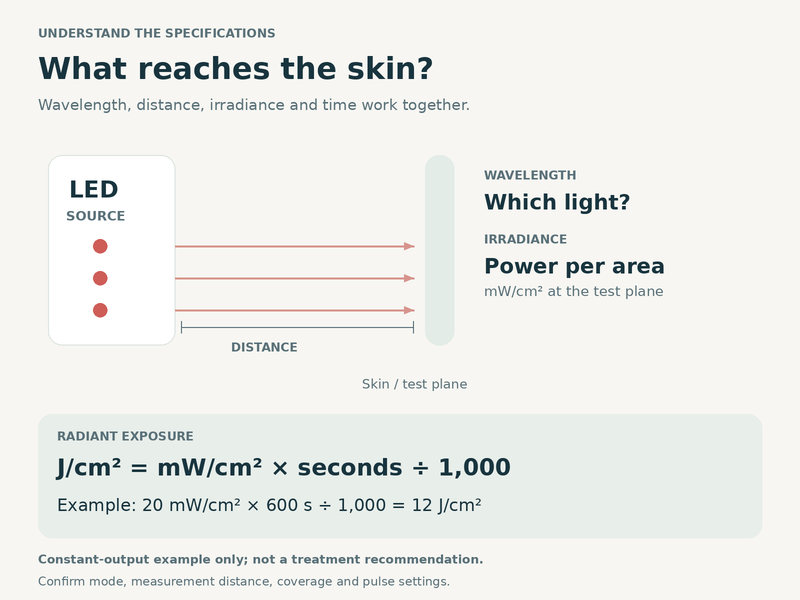
Wavelength identifies the light spectrum. Irradiance measures incident power per area. Exposure time helps determine radiant exposure. Distance, coverage, pulsing, and fit also affect delivery, so neither brightness nor LED count establishes the treatment dose.
I separate the main measurements.
| Peak wavelength, nm | Where an emission band peaks | What are the peak and tolerance for each channel? |
| Irradiance, mW/cm² | Optical power reaching a unit area | Where, at what distance, and in which mode was it measured? |
| Radiant exposure, J/cm² | Incident energy per unit area over time | How was it calculated or measured? |
| Coverage | How output varies across the treatment area | Is there an output map, rather than one center reading? |
| Pulse settings | Timing of intermittent output | Is the value peak or time-averaged? |
| Session duration | Exposure time | Does it match the evaluated protocol? |
For steady output, a simple calculation is:
Radiant exposure (J/cm²) = irradiance (mW/cm²) × time (seconds) ÷ 1,000.
For example, an assumed constant 20 mW/cm² over 600 seconds gives 12 J/cm² at the measurement plane. This is an arithmetic example, not a treatment recommendation. It does not describe how much energy a particular skin layer absorbs.
A real Nicemay specification illustrates the questions.
Nicemay’s public LED mask page lists 220 light beads, three intensity modes, and an irradiance statement of 43 ± 5 mW/cm². A comparison table also describes output up to 43 mW/cm² in an anti-aging mode.[6]
I would treat these as published supplier specifications, then confirm the mode, measurement distance, channel contributions, and output distribution for the sample being purchased. The figures alone do not establish clinical effectiveness.
I would also request the current approved specification because a website comparison table is not a substitute for a model-specific test report. If the housing, optics, firmware, or light channels change during customization, I would review whether the previous measurements still describe the finished product.
How should users approach safety and a home-use routine?
A convenient home format can make extra sessions seem harmless. I would build the routine around the device instructions and the user’s suitability.
I would follow the specific device instructions for timing, frequency, preparation, and eye protection. People with photosensitivity, relevant medicines, or skin conditions should seek medical advice. Stop use if irritation or eye symptoms persist.
I would check suitability before frequency.
The AAD recommends considering light-sensitive conditions and medicines before using red-light devices. It also advises following the specified eye-protection instructions and highlights pigmentation concerns for darker skin tones.[4]
I would not turn those points into a universal schedule for every mask. Product outputs differ, and the research protocols in this guide are examples of what investigators tested. They are not interchangeable user instructions.
I would expect a usable manual to explain preparation, treatment limits, cleaning, and what to do if discomfort occurs. If the instructions require protective goggles, closing the eyes or substituting sunglasses is not equivalent.[4]
I would keep the skincare routine simple.
I would follow the manual on whether skin should be clean and dry and whether a particular topical product is compatible. I would not assume that adding an acid, retinoid, serum, or sheet mask improves light treatment. Any recommended combination needs its own compatibility basis.
If burning, persistent redness, discomfort, or visual symptoms occur, I would stop the session and seek appropriate advice rather than increase exposure. A person who is pregnant or managing a health condition should ask a clinician about suitability; an absence of product data is not a safety finding.
I would assess progress consistently.
I would compare photographs taken with similar lighting, camera settings, angle, and skincare conditions. I would also record the device mode and use schedule. Even then, I would distinguish customer photos and satisfaction comments from controlled evidence.
For product teams, explicit instructions are part of sample evaluation. I would ask whether an ordinary user can understand the limits without a sales representative explaining them.
How should beauty brands choose an LED device?
An attractive sample can move a project forward quickly. I would still confirm the product’s evidence and technical details before committing to packaging or volume production.
I would choose an LED device by intended use, measured output, supporting evidence, usability, and target-market requirements. For OEM and private-label projects, I would verify the final configuration and documents before approving product claims.
I start with the product brief.
I would define the target customer, main skin concern, sales channel, price position, and likely routine. An acne-focused product and a wrinkle-focused product may need different evidence, instructions, and market pathways.
I would then compare the physical format. Fit, straps, controls, cleaning access, and treatment-area coverage are practical features worth testing. I would record user comments as usability feedback, rather than present them as proof of wrinkle reduction.
I request evidence for the finished model.
| Optical output | Spectral data, irradiance test conditions, mode settings, and coverage information |
| Safety | Relevant electrical, thermal, and optical safety evaluation for the intended design and use |
| Performance claims | Evidence tied to the model, protocol, population, and outcome being claimed |
| Market documents | Documents that match the exact model and intended market |
| Настройка | A record of changes and a decision on which checks need repeating |
| Production | Agreed specifications, inspection criteria, and change-control arrangements |
I would verify terminology as carefully as the documents. The FDA states that establishment registration and device listing do not mean approval, clearance, or authorization.[7] I would never use a registration certificate as proof of a model’s clinical results.
For a Nicemay project, our red light therapy OEM and private-label page provides a starting point for platform discussions. Our beauty device product selection guide can help define the wider range.
Planning an LED skincare product? Share your target market, main skin concern, preferred format, and estimated quantity with Nicemay. We can discuss a suitable platform and the specifications to review during sampling.
Заключение
I would choose LED therapy based on skin concern, measured output, and credible evidence. Explicit instructions and realistic claims matter more than the number of colors.
О компании Nicemay
I write from Nicemay’s perspective as a Shenzhen-based OEM/ODM manufacturer of beauty and personal care devices. We work with brands, importers, distributors, and retailers on product selection and private-label development.
Список литературы
[1] Lee SY et al. (2007). Randomized, placebo-controlled, double-blinded, split-face study of LED phototherapy for skin rejuvenation. PubMed record and abstract.
[2] Papageorgiou P, Katsambas A, Chu A. (2000). Phototherapy with blue (415 nm) and red (660 nm) light in the treatment of acne vulgaris. PubMed record and abstract.
[3] He X et al. (2026). Efficacy and Safety of 590 Nm and 590/630 Nm Light-Emitting Diode Therapy for Sensitive Skin: A Prospective Randomized Controlled Trial. Publisher abstract.
[4] American Academy of Dermatology. Is red light therapy right for your skin?.
[5] American Academy of Dermatology. Lasers and lights: How well do they treat acne?.
[6] Nicemay. Red Light Therapy Mask Manufacturer / OEM ODM Private Label. Public supplier specifications checked November 4, 2026; confirm current model-specific documents before purchasing or publishing numerical claims.
[7] US Food and Drug Administration. Important Reminders about Registration and Listing.