What Does EMS Mean on a Facial Massager?
An EMS button can make a facial massager difficult to understand: is it massage, microcurrent or something else? Confusion grows when tingling and promises of lifting are presented together. At Nicemay, we separate the abbreviation from the device’s actual output and supporting evidence, so consumers can read the instructions more carefully and beauty brands can explain the feature without overstating it. 1 2
Quick answer: EMS usually means electrical muscle stimulation on a facial massager. It describes an electrical-stimulation feature intended to activate muscles through motor nerves, not ordinary vibration. The label alone does not establish the device’s output, suitable use areas or cosmetic results. 1 4
Summary: Understanding EMS starts with three separate questions: what the mode is called, what the finished device delivers, and what its evidence supports. EMS is not another name for vibration, RF heating or LED light. Microcurrent is a related electrical-stimulation term, but not simply EMS turned down. Sensation cannot classify either technology or prove effectiveness. A facial NMES trial offers limited, device-specific evidence, not a guarantee for every massager. For consumers, the model’s instructions matter; for brands, we recommend matching terminology, technical documents and claims before approving packaging or product education. 1 2 3 6
What does EMS stand for in a facial massager?
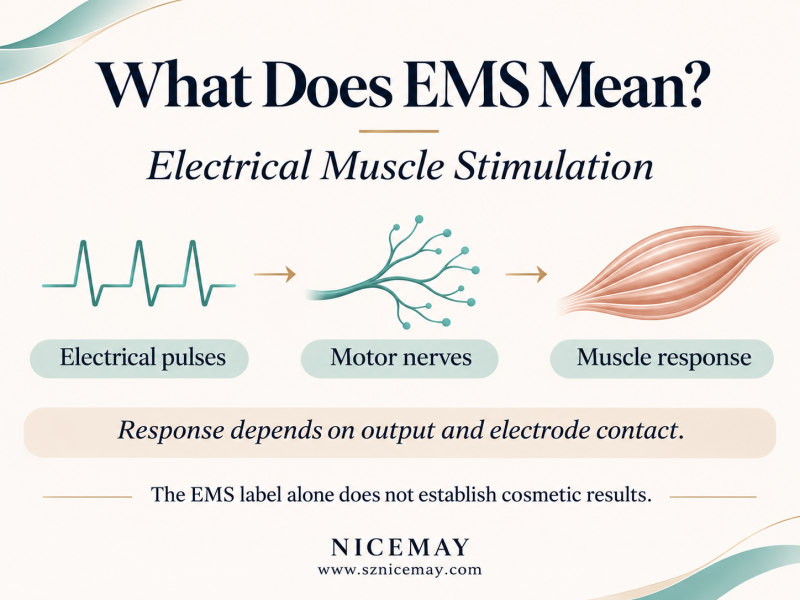
EMS generally stands for electrical muscle stimulation. NMES, or neuromuscular electrical stimulation, emphasizes the nerve–muscle pathway involved. In conventional stimulation of muscles with intact nerve supply, electrical pulses can activate motor nerve fibers and produce contraction. Sensory fibers may also be stimulated; EMS does not act only on muscle while bypassing nerves and the skin interface. 1
“Facial massager” describes a product format, not a standardized electrical output. Likewise, “EMS in skincare” usually identifies a device feature rather than a property of a cream. We recommend reading the mode description alongside the model’s technical documentation. Neither a skincare association nor a toning label establishes enhanced ingredient absorption or a verified lifting result. 1 3 4
Our face-toning product platforms provide a starting point for format and feature discussions. We treat that overview as a project introduction, not proof that every listed configuration delivers the same stimulation or has the same evidence.
What does the EMS mode actually do?
An electrical-stimulation mode applies a time-varying electrical signal through contact electrodes. Whether it produces a particular response depends on the output and the electrode–skin interface. Amplitude, pulse timing and electrode conditions matter together. The presence of metal contacts or an EMS icon is therefore not enough to demonstrate a defined neuromuscular response in the finished product. 1 4
The electrical function is also separate from the power needed to charge or run the device. A battery rating or power-input figure does not describe the signal delivered at its electrodes. We recommend keeping charging specifications out of explanations of EMS intensity; consumers should not interpret a larger input rating as stronger stimulation or better cosmetic performance. 4 7
A multifunction massager may also vibrate, warm its contact surface or emit light. Those experiences should not be used as evidence that its EMS channel is active. We recommend explaining which functions operate in each mode and whether they can be selected separately. A combined mode still needs an accurate description of each contributing function, rather than one broad “EMS rejuvenation” claim. 1 3 4
For example, our MR-2368 platform page introduces an EMS-labelled product. Its public specification does not fully define the waveform and loaded output. We would confirm those details for the proposed configuration; the page is not clinical evidence or confirmation of permitted neck use. 8
Is EMS the same as vibration, microcurrent or RF?
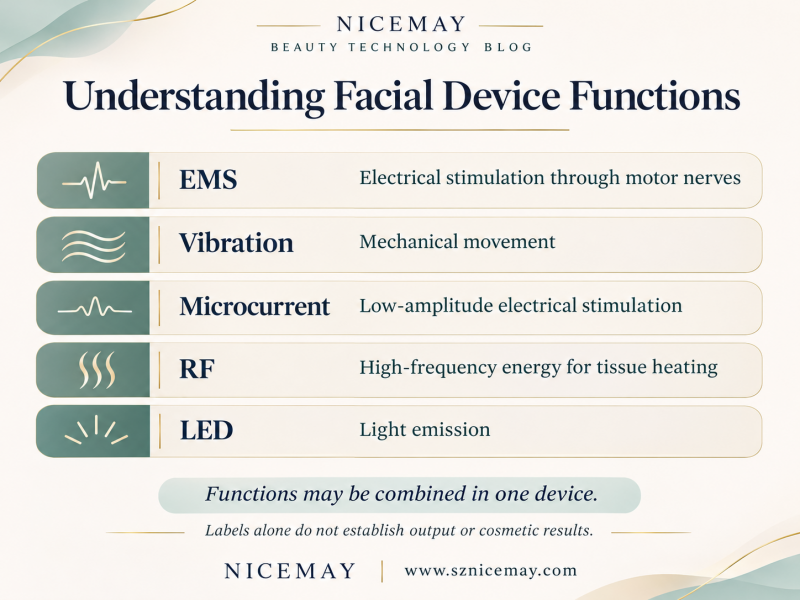
No. These terms describe different kinds of functions, although one product may combine them. The table explains their basic meaning, not an effectiveness ranking. A visible light, warm surface or pulsing sensation cannot substitute for confirmation of the relevant output. 1 2 3
| Label | Basic meaning | What it does not establish |
|---|---|---|
| EMS | Electrical stimulation intended to activate muscles through motor nerves. | A lifting result for every device. |
| Vibration | Mechanical movement, rather than EMS-type electrical stimulation. | That an EMS output is present. |
| Microstroom | Usually low-amplitude electrical stimulation; definitions and protocols vary. | Simply EMS at a lower setting. |
| RF | High-frequency electrical energy used to produce tissue heating. | The same mechanism as EMS. |
| LED | Emitted light used for photobiomodulation. | Electrical muscle stimulation. |
Microcurrent and EMS terminology can overlap in publications and marketing. We recommend checking intended stimulation, waveform and measured output rather than classifying a product from microamp or milliamp units alone. For broader platform context, our RF, microcurrent and EMS brand-selection guide addresses the category discussion; model-specific verification remains necessary. 1 2 3
For the mechanism, evidence and positioning questions behind these labels, see our EMS and microcurrent facial device comparison.
Why might an EMS massager tingle—or feel different between users?
Electrical stimulation can recruit sensory as well as motor fibers. Its perceived intensity depends on several factors, including pulse parameters, electrode contact and the conductivity of the interface. Different contact conditions can therefore change the experience even when the displayed setting is unchanged. A setting number is not a universal measure of what every person will feel. 1
A stronger tingle does not prove better toning, and an absence of obvious sensation does not identify the output as microcurrent or prove a fault. We recommend following the model’s instructions, not increasing intensity to chase a sting or copying another user’s preferred setting. Product education should separate comfort feedback from any measured cosmetic endpoint. 1 2
Redness and pain are not signs that a treatment is working. FDA consumer information reports skin irritation, burns and pain among electrical-stimulator risks. If an unexpected reaction occurs, stop using the device, follow its instructions for use and seek appropriate professional advice. Do not treat discomfort as a necessary stage before a benefit appears. 5
Does an EMS label prove lifting or skin-tightening results?
No. A mechanism explains how stimulation may occur; it does not establish the size, duration or visibility of a cosmetic change. Muscle response, skin measurements and perceived appearance are different endpoints. We recommend stating exactly what a finished-device study assessed rather than converting “electrical muscle stimulation” into a promise of permanent contour change. 1 3 6
A 2012 randomized controlled trial involving 108 healthy women studied a particular facial NMES device over 12 weeks. It reported increased ultrasound thickness of a local facial muscle and subjective appearance improvements. However, there was no sham-stimulation control, participants were not blinded and the manufacturer funded the research. Those findings cannot be transferred to Nicemay models or all EMS-labelled massagers. 6
That trial did not prove collagen production, facial ATP increases, fat reduction or lasting lifting after stopping use. Laboratory, wound-healing and rehabilitation findings also cannot establish those outcomes for a cosmetic massager. We recommend keeping any claim tied to the tested finished device, population and endpoint; adding “temporary” does not remove the need for supporting evidence. 1 2 6
What should the manual and product label make clear?
For consumers, the model’s instructions for use, or IFU, should be the starting point—not a generic online routine. We recommend clear mode names, controls and intended use areas, with illustrations specific to the finished product where appropriate. A facial-device name should not be interpreted as permission to stimulate any facial or neck location. 4
The FDA’s powered-muscle-stimulator guidance includes warnings about neck, mouth and certain other stimulation routes. It covers a specific regulated product category, not a universal beauty-device instruction sheet. We therefore recommend reviewing the intended areas against the actual design, IFU and target market rather than borrowing an electrode route from another device or assuming low current removes the concern. 4
We also recommend model-specific instructions for any required conductive medium, cleaning, permitted accessories and use limits. Contraindications, precautions and abnormal-response instructions should be easy to find. People with implanted electronic devices should not assume an EMS beauty label makes use suitable; FDA information identifies possible interference with pacemakers and defibrillators. Follow the product restrictions and seek professional guidance as appropriate. 4 5
There is no session length or weekly frequency that this article can responsibly assign to every EMS massager. A study schedule belongs to its tested protocol. We recommend using the final model’s validated instructions rather than importing a research regimen or a competitor’s routine. 4 6
What should a beauty brand confirm before using EMS terminology?
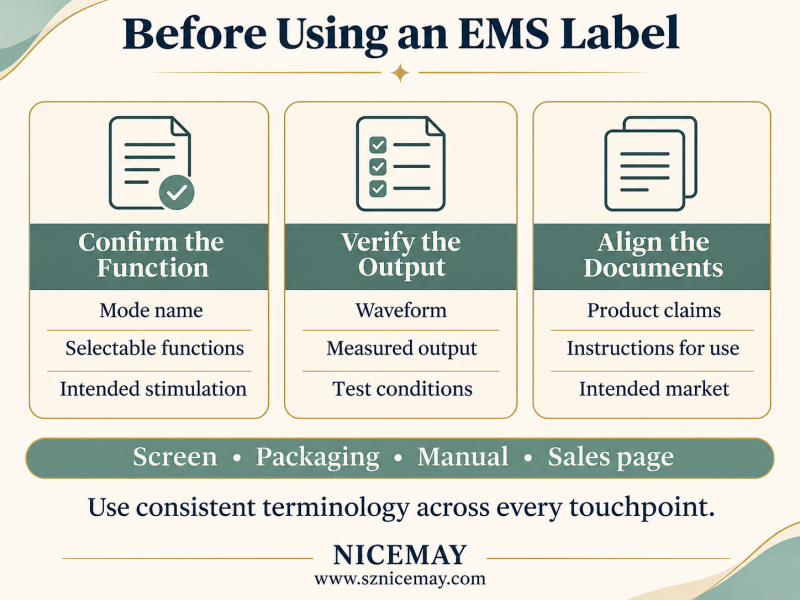
We recommend three concise checks before packaging approval. First, confirm which electrical function the label describes and what the user can select. Second, check that technical documents define the waveform and measured output under stated conditions. Third, make sure the claims and IFU match the proposed finished configuration and intended market. This is our development recommendation, not a claim that FDA mandates an identical checklist for every cosmetic product. 4
Our MR-2622 roller platform illustrates why terminology needs checking: the product title uses Micro-Current, while its public specification includes EMS operation. That document does not fully establish loaded current and waveform definitions. We would not infer a verified microamp output from the title or convert a voltage field into skin current without suitable measurements. 7
For label review, we recommend comparing the same mode name across the screen, packaging, manual and sales page. If one says “microcurrent” and another says “EMS,” resolve the difference with the technical team rather than treating the terms as automatically interchangeable. This is an editorial consistency step: it does not replace output verification, a claims review or the market assessment for the proposed device. 2 4 7
Through our beauty-device verification discussions, we recommend agreeing which documents support the final model and which questions remain open. Technical verification and cosmetic evidence serve different purposes. Registration language also needs care: FDA registration and listing do not establish approval, clearance or authorization. Neither a factory entry nor another product’s study is a substitute for model-specific support. 4 6 9
For a more detailed purchasing framework, read our guide to specifying a facial EMS device.
What should brands remember about the EMS label?
Bottom line: EMS usually means electrical muscle stimulation, not a guarantee of lifting. We recommend aligning the label with the finished device’s output, instructions and evidence. Clear terminology helps explain the feature without using sensation or borrowed research as proof. 1 4 6
To discuss an EMS-labelled facial-device project with Nicemay, contact our team with your proposed format, target market and draft feature wording.
What are the common questions about EMS on facial massagers?
Does EMS mean the device only massages the face?
No. EMS identifies an electrical-stimulation function, not just mechanical massage. A product may combine electrical stimulation with other features, but its mode description and technical documents should identify what actually operates. 1 4
Is microcurrent simply a lower EMS setting?
Not as a general rule. Lowering amplitude does not, by itself, define a different technology. Intended stimulation, waveform and measured output matter; microamp units and an absence of tingling are insufficient to classify the mode. 1 2
Should every EMS massager produce a noticeable tingle?
There is no universal sensation test. Output and contact conditions affect perception, and discomfort is not evidence of efficacy. Follow the model’s IFU; stop for an unexpected reaction and seek appropriate professional advice rather than increasing strength to prove it works. 1 5
Does the EMS label prove collagen or ATP benefits?
No. The label does not demonstrate either outcome in a finished facial device. The facial NMES trial discussed here did not establish those benefits, and laboratory or body-exercise findings cannot be repackaged as evidence for a Nicemay massager. 2 6
Can an EMS massager be used every day?
This depends on the specific device and its validated instructions, not the abbreviation. We recommend following its session limits and schedule rather than assuming a trial protocol or another product’s daily routine applies. This article does not provide a universal frequency. 4 6
Bronvermeldingen
[1] Doucet, Lam and Griffin (2012): Neuromuscular Electrical Stimulation for Skeletal Muscle Function
Return to text
[2] Kolimechkov et al. (online 2022; issue 2023): Physiological effects of microcurrent and its application for maximising acute responses and chronic adaptations to exercise
Return to text
[3] Bu et al. (2024): Development of Home Beauty Devices for Facial Rejuvenation: Establishment of Efficacy Evaluation System
Return to text
[4] FDA: Guidance Document for Powered Muscle Stimulator 510(k)s (June 1999)
Return to text
[5] FDA: Electronic Muscle Stimulators — Consumer Information
Return to text
[6] Kavanagh et al. (2012): Use of a neuromuscular electrical stimulation device for facial muscle toning: a randomized, controlled trial
Return to text
[7] Nicemay MR-2622 Technical Specification — July 2026
Return to text
[8] Nicemay MR-2368 Technical Specification — July 2026
Return to text
[9] FDA: Important Reminders about Registration and Listing
Return to text
keyword: what does ems mean on my facial massager; ems meaning beauty; what is EMS in skincare; EMS beauty device; electrical muscle stimulation facial