
CUSTOMER CASE STUDY · FACIAL GROOMING DEVICE OEM
From a Compact Hair-Removal Platform to a Beauty-Led Facial Grooming Tool
How Nicemay supported the development of a compact facial-grooming platform into ReFa SKIM SHAVER—a beauty-focused device designed to remove facial peach fuzz with a guarded cutting structure, LED-assisted visibility and a simple twist-to-use routine.
Client :
ReFa
Produit final :
ReFa SKIM SHAVER
Plateforme d'origine :
Nicemay QM-1786 Electric Facial Hair Remover
Core structure
Inner blade + slit guard / hidden smooth knife net
Key interaction:
LED ring light + rotate to use or store
Positionnement commercial :
Compact beauty tool for smoother-looking skin and makeup preparation

À PROPOS DU PROJET
Build a beauty tool, not a conventional shaver
ReFa positions SKIM SHAVER around effortless facial peach-fuzz removal, smoother-looking skin and easier skincare and makeup application. The product page states that the shaver uses a double-layer construction: a slit guard sits over the sharp inner blade, helping the inner blade avoid direct skin contact while the user glides the device in small circles.
This product direction creates a different development brief from a conventional grooming trimmer. The device must work at the facial surface, where visibility, contact feel, skin comfort, compact size, hygiene and beauty-led visual language matter as much as the cutting action.
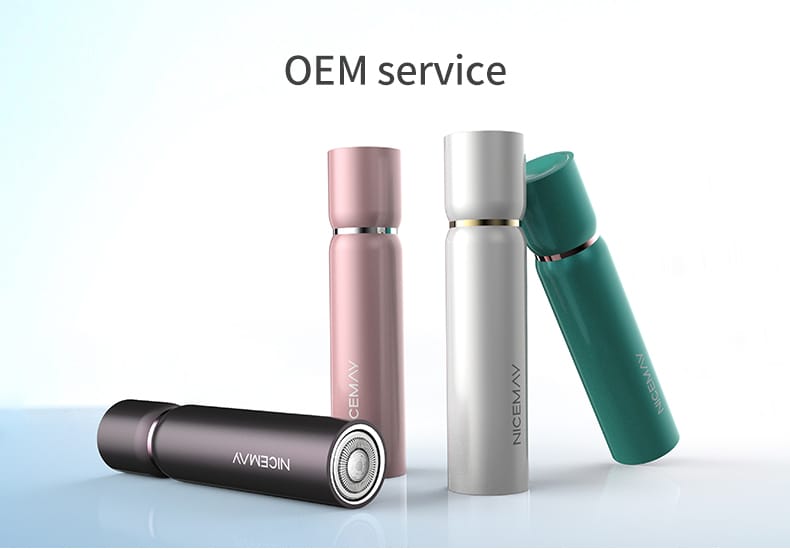
Nicemay’s QM-1786 platform provides the structural basis for this category: a 27 mm-diameter, 112.4 mm-high, 53 g ABS body with a stainless head, hidden smooth knife net, LED light circle, rotary switch, hair-storage area, cleaning brush, pouch and one-AA battery chamber.
LE DÉFI
Quatre contraintes spécifiques liées au projet OEM
The project required an engineering response to the way light, facial geometry, eye protection and repeated home use interact-not just a new product name.
01 / The cutting system had to work close to the skin without behaving like an exposed blade
Facial peach fuzz is short, light and often flat against the skin. The product needs to pick up and cut these fine hairs without asking the user to press hard. But moving a sharp blade closer to the skin also increases the risk of discomfort, drag or accidental damage when the device changes angle around the upper lip, cheek, chin or jawline.
The underlying engineering question is precise: how can the guard opening admit fine hair while keeping a reliable skin-to-blade stand-off across real facial angles?
02 / The user needed to see fine hairs before the device could remove them
Vellus hair is easy to miss in normal bathroom lighting. The problem becomes more obvious around the upper lip, chin, jawline and the edges of the face, where fine hair may not be visible from the user’s usual mirror angle. If the customer cannot see the hair, a technically capable cutter still produces an uncertain grooming experience.
ReFa uses a circular LED ring to illuminate a broad area around the shaving head, helping the user see short, thin hairs and reduce missed spots. The Nicemay platform also includes a built-in LED light circle. The design task was to integrate the light around the cutting system without casting a strong head shadow, creating glare in the mirror or adding unnecessary bulk to the head.
03 / The form had to move through facial contours without turning grooming into a technical task
The facial surface is not one large flat area. Wider zones such as the cheeks and forehead need efficient coverage, while smaller areas around the mouth and eyes require a more controlled path. ReFa instructs users to gently press the device against dry skin and glide it in small circles. It distinguishes wider cheeks and forehead from smaller eye and mouth areas, while specifically excluding eyelid use.
For an OEM project, this creates a form-factor and instruction-design challenge. The head diameter, device weight, center of gravity, grip radius and guard profile must support a low-pressure circular motion rather than encourage aggressive back-and-forth shaving.
04 / Storage protection had to be built into the body, not added as a loose accessory
A loose cap protects a grooming head, but it can also be lost in a makeup bag, bathroom drawer or travel pouch. ReFa instead presents a compact lidless design: the user rotates the device to reveal the shaving head for use, then rotates it in the opposite direction to store it.
This creates a specific mechanism challenge. The rotary action must provide an intuitive open/close direction, a repeatable end position, sufficient torque to prevent accidental movement, and a reliable relationship between the visible switch marks, LED activation and head exposure. If the rotation is too loose, the device can move during travel. If it is too tight, it stops feeling like a quick beauty tool.

NOTRE SOLUTION
From a Proven Hair Remover Platform to a Complete Product System
01 / Separate the skin-contact plane from the cutting plane
The core safety architecture is to place a protective outer guard between the skin and the cutting blade.
It is that the outer guard establishes the skin-contact plane, while the inner blade performs the cutting action behind it. The guard opening, guard thickness, blade position and operating clearance must be developed as one controlled assembly.
02 / Place a circular light source around the grooming zone
An LED ring light turns visibility into a functional part of the grooming process. ReFa states that its ring illuminates the skin in a large circle to make short, thin facial hairs easier to see.
The solution is more specific than adding an LED to the front of the device. The ring needs concentric placement around the head, controlled light diffusion, adequate brightness for mirror use, and shielding that prevents direct glare toward the user. It must also leave sufficient space for the guard, blade support and hair path.
03 / Tune the body around low-pressure, circular facial movement
The compact cylindrical platform supports one-handed control. Nicemay specifies QM-1786 at 27 mm in diameter, 112.4 mm in height and 53 g. ReFa specifies its finished product at approximately 27 mm × 27 mm × 112 mm and 55 g.
These dimensions suit a beauty-led use path: hold the device like a compact cosmetic accessory, place the head lightly on dry skin, and make small circular passes instead of using a broad shaving stroke. The final grip texture, balance point and head profile should be validated with representative users across the upper lip, cheek, jawline and chin areas.
04 / Integrate use and storage through a rotary mechanism
a single rotational action prepares the device for grooming, and the reverse action returns it to its storage state. The rotary assembly needs deliberate control of direction, torque, detents or end stops, position marking and interaction with the electrical switch. This keeps the product compact without introducing a separate cap the user has to carry.
Choix des matériaux
Approvisionnement en matériaux adaptés à la fabrication des projets
The material selection had to satisfy four requirements at the same time: skin-friendly stainless steel ; support injection molding, cosmetic color; the electronics had to be protected during repeated use; and the finished product had to support a premium retail presentation.
01 / Skin-facing guard and inner cutting blade — stainless steel
The guard and inner blade are the most safety-sensitive material pair in the product. ReFa states that the double-layer structure is made from skin-friendly stainless steel and that the blade uses a special stainless material intended to minimize irritation.
The engineering requirement is not merely “use stainless steel.” The outer guard needs corrosion resistance, a clean edge, stable opening geometry and a finish that remains smooth against the skin. The inner blade needs a cutting edge that retains performance, stays aligned with the guard and does not create metal debris during its intended life cycle.
02 / Guard aperture and head-support structure
The outer guard is not a passive cover. Its slit pattern, thickness, curvature, support ribs and attachment method determine how fine hair enters the cutter and how the guard maintains separation from the inner blade. A guard that is too open can reduce protection; a guard that is too closed can make fine hair harder to capture.
The supporting structure also needs to maintain concentricity between the guard and inner blade during assembly, travel vibration and repeated facial contact.
03 / ABS body, rotary sleeve and battery cover
Both published product pages identify ABS in the product body. ABS is a practical direction for a compact battery-powered beauty device because it can support injection molding, cosmetic color, molded symbols, internal ribs, battery-cap threads or latches, and a lightweight handheld form.
The key manufacturing trade-off is dimensional stability around the rotary mechanism. A body that is too thin can flex, which changes rotary feel or creates housing gaps. A body that is too thick adds weight and can make a compact device feel less refined. Wall thickness, draft angle, rib placement, texture, parting line and gate location should be reviewed together during DFM.
04 / LED ring, optical carrier and light-diffusion material
The LED ring must make fine hairs more visible without visually overpowering the treatment head. A transparent or translucent optical carrier is normally evaluated around the LED array, but the final optical material and light-guide construction are not publicly disclosed.
The final material needs to balance light transmission, diffusion, yellowing resistance, cosmetic appearance, assembly tolerance and resistance to powder, skincare residue and brush cleaning. The light ring should also be positioned so that it does not create a deep shadow directly in front of the guard.
Processus de fabrication
From mold review to Product molding
01 / DFM review of the double-layer cutting architecture
The project should begin with a DFM review of the blade head as a complete system: outer slit guard, inner blade, blade support, guard support, hair path, LED ring, head attachment and cleaning access.
The most important decision is the guard-to-blade relationship. The outer guard must protect the skin while allowing fine hair to enter the cutting zone. The inner blade must cut efficiently behind the guard without making contact with it during rotation. Before tooling or component release, the team should define the guard profile, opening pattern, controlled working clearance, head concentricity, allowable runout, attachment method and brush-access path.
This review should be based on released drawings and functional samples. It should not be replaced by visual approval of a cosmetic mock-up.
02 / Form and finish the guard and inner-blade components
Depending on the approved guard design, the outer stainless component may be evaluated through precision stamping and forming, electroforming, laser processing or another suitable controlled route. The inner blade may require its own precision forming, sharpening and heat-treatment route. The actual manufacturing process must follow the approved component drawings and supplier capability.
The critical issue is edge quality. Burrs, sharp guard edges, distorted openings, inconsistent curvature or a contaminated finish can change the skin-contact feel and undermine the “gentle” product promise. The inspection plan should define critical visual zones, burr criteria, edge-finish criteria, dimensional checks and corrosion resistance appropriate to the chosen material and market.
03 / Assemble the blade head with controlled clearance and concentricity
The guard and inner blade must be assembled using defined location features and a fixture that controls concentricity and axial position. Visual alignment alone is not sufficient. A small shift can create local contact, noise, poor cutting performance, vibration or a change in the intended skin-to-blade spacing.
The assembly process should check head runout, rotation torque, blade-to-guard clearance, engagement of the head attachment, hair-flow path and retention under normal use. A functional test using representative synthetic fiber or approved hair-media samples can help verify capture and cutting behavior without treating the result as a clinical skin test.
04 / Conduct final functional, cosmetic and use-guidance checks
Final inspection should go beyond “the motor turns on.” The control plan should cover blade-head retention, guard condition, rotation smoothness, motor noise and vibration, LED activation, battery contact, switch function, hair-storage closure, brush fit, pouch fit, product color, surface defects, retail packaging, markings and instruction-manual consistency.
From Platform to Brand Product
Quels changements interviennent lorsqu'une plateforme OEM devient un produit de marque ?
The OEM value was not simply the ability to change color or add a logo. The platform was translated into a beauty-led product system: guarded hair removal instead of exposed-blade language, LED-supported visibility instead of an ordinary trimmer light, a compact twist-to-use interaction instead of a loose cap, and a dry-maintenance routine with brush, pouch and clear instructions.

PLATEFORME OEM NICEMAY
Nicemay QM-1786 platform >>>
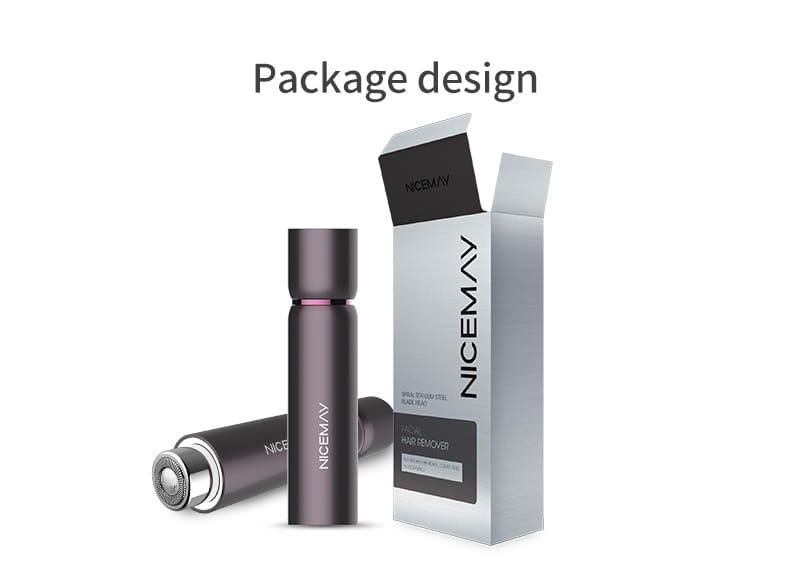
A compact electric facial hair remover with a Φ27 mm × 112.4 mm, 53 g ABS body; stainless head; hidden smooth knife net; built-in LED light circle; rotary switch; hair-storage area; one-AA battery chamber; cleaning brush; pouch; manual; OEM color options; and retail-box presentation.
Produit client
ReFa SKIM SHAVER >>>
ReFa SKIM SHAVERA compact beauty-focused facial shaver publicly specified at approximately 27 mm × 27 mm × 112 mm and 55 g, using ABS and stainless steel. Its brand story centers on double-layer smooth skim shaving, LED ring light, rotate-to-use / rotate-to-store interaction, dry-skin application and white or pink product options.
LA RÉACTION DU MARCHÉ
A Facial Grooming Product Positioned as Part of a Beauty Routine
ReFa SKIM SHAVER gives the brand a specific beauty-led answer to facial peach fuzz. Rather than communicate only “hair removal,” the official product page links gentle shaving to brighter, smoother-looking skin and easier skincare and makeup application.
The publicly visible product system includes white and pink versions, a compact lidless rotate-to-use design, LED-assisted visibility, a battery-cover opener, cleaning brush, pouch and instruction manual. The official price listed on the English product page is ¥5,280 including tax at the time of research.
ReFa also supports the positioning with practical usage guidance: use on dry skin, glide in small circles, use on facial peach fuzz only, do not use on eyelids, do not rinse with water, and use the supplied brush for cleaning. This moves the product from a one-time gadget purchase toward a defined and repeatable beauty-maintenance routine.
Signaux visibles par le public
- Beauty rather than grooming language: smoother-looking skin, skincare and makeup support.
- Portable product architecture: compact, lidless rotate-to-use / rotate-to-store design.
- Choice at retail: White and Pink versions listed publicly.
- Public price signal: ¥5,280 including tax at the time of research; recheck before publication.
- Defined accessory and care system: battery-cover opener, brush, pouch and manual.
Ces informations peuvent être mises à jour conformément à la stratégie marketing du client ; les informations fournies par le client feront foi.
Planning a Beauty-Led Facial Hair Remover for Your Brand?
Share your target market, facial-hair use case, preferred blade-guard concept, LED requirements, desired body colors, battery route, water-resistance target, packaging direction and expected customization level. Nicemay can help you evaluate the right OEM or ODM route—from platform adaptation and engineering validation to production and retail packaging.