Compare at-home beauty devices vs professional facials.
Professional facials offer hands-on care and access to professional equipment. At-home beauty devices offer convenience, but confusing the two can lead to unrealistic expectations and weak product positioning.
Direct answer: At-home beauty devices can support regular skincare routines, but they do not fully replace every professional facial or in-office aesthetic procedure. Their suitability depends on the technology, device design, intended use, user needs, and evidence behind the product.
For beauty brands, the opportunity is not to promise that home devices can do everything a professional treatment can do. It is to offer products with clear benefits, realistic claims, and a well-defined place in the customer’s skincare routine.
What Is the Difference Between At-Home Devices and Professional Facials?
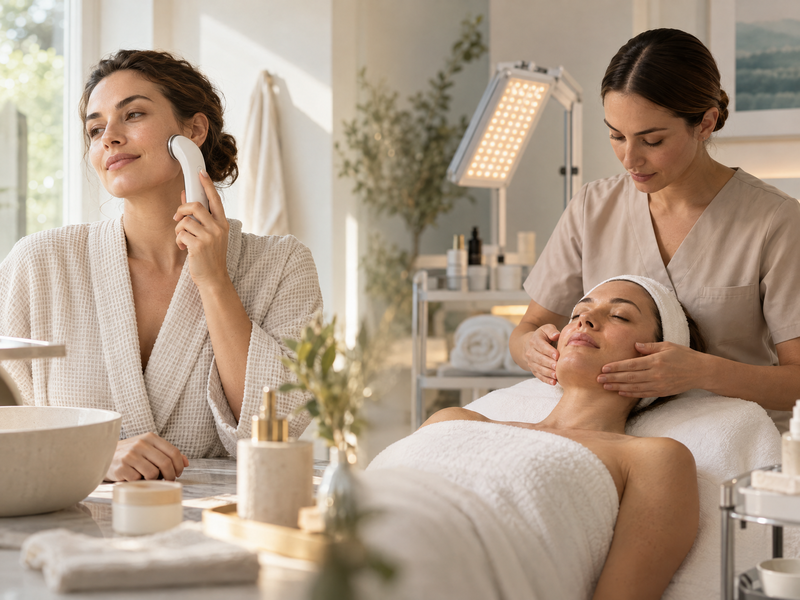
The main difference is not simply where the treatment takes place. Home-use devices and professional treatments can differ in technology, energy delivery, treatment protocols, user supervision, and intended outcomes.
How do the two options compare?
Professional facials cover a wide range of services, from basic cleansing and moisturizing to treatments delivered by trained practitioners. At-home beauty devices also vary widely. A cleansing brush, LED device, microcurrent device, and RF facial tool should not be treated as equivalent products.
The following table offers a general comparison. Actual capabilities depend on the specific product and service.
| Factor | At-home beauty devices | Professional facials and treatments |
|---|---|---|
| Main setting | Personal use at home | Clinic, salon, or professional treatment setting |
| Convenience | Can fit into a personal routine | Usually requires an appointment or visit |
| User | Consumer following product instructions | Practitioner or professional, depending on the treatment |
| Equipment | Designed for the product’s specified home-use purpose | May include a wider range of equipment and treatment options |
| Treatment intensity | Depends on the device and its intended use | Varies widely by procedure and equipment |
| Personalization | Based on the user’s product choice and instructions | May involve professional assessment and an adjusted treatment plan |
| Cost structure | Initial device purchase plus any ongoing consumables | Per-visit or treatment-plan costs |
| Evidence requirements | Product-specific evidence and clear instructions remain important | Evidence and professional standards depend on the treatment and jurisdiction |
A professional facial is not automatically more effective for every skincare goal, and a home device is not automatically appropriate for every user. The right choice depends on the treatment and the individual’s needs.
Does using a device at home mean getting the same treatment?
No. A home-use product and a professional device may use the same broad technology while differing in design, operating parameters, safety controls, and intended use.
For example, the term “RF” describes a technology category. It does not establish that two RF products deliver the same treatment or produce comparable outcomes. The same principle applies to LED, microcurrent, and other beauty technologies.
A brand should therefore avoid using the shared technology name as the only basis for a claim of equivalence. If a product is designed for regular home skincare, its positioning should reflect the specific use and evidence that support it.
Which Skincare Needs Can At-Home Beauty Devices Support?
Home-use devices may support selected skincare goals when their technology, instructions, and evidence match the intended use. Brands should define the need they want to address before selecting a device type.
For brands considering RF products, understanding the difference between home-use and professional treatments is only the first step. You should also review the available evidence, device specifications, and safety requirements. Read our guide: Do At-Home RF Devices Work? A Specification and Safety Guide for Brands.
Which technologies serve different product purposes?
Home-use beauty devices can be grouped by their primary function. These categories are starting points for product selection, not guarantees of clinical results.
| Device category | Potential product positioning | What brands should verify |
|---|---|---|
| Skin cleansing devices | Support a regular facial cleansing routine | Cleaning method, skin-contact materials, maintenance, and instructions |
| LED beauty devices | Support a light-based skincare routine for the specified intended use | Wavelength, output measurement, exposure instructions, eye-safety considerations, and evidence for claims |
| RF facial devices | Support a home-use facial care routine with RF technology | Output specifications, temperature controls, operating instructions, product-specific evidence, and relevant safety testing |
| Microcurrent facial devices | Offer a device-based facial care experience using microcurrent technology | Output parameters, contact requirements, controls, instructions, and evidence for intended claims |
| EMS facial devices | Offer a facial care product using electrical muscle stimulation | Electrical output, electrode design, use instructions, contraindications, and evidence for intended claims |
| Facial massage tools | Support a manual or powered massage routine | Contact design, materials, ergonomics, cleaning, and intended-use instructions |
A brand may choose one core function or combine technologies, but adding functions does not automatically create a better product. Each function should have a clear customer purpose and appropriate technical support.
Why does convenience matter?
One potential advantage of home-use devices is that consumers can use them as part of their regular routine without arranging a professional appointment each time. This may appeal to customers who value convenience and prefer to manage some aspects of skincare themselves.
However, convenience should not be confused with proven efficacy. A device still needs clear instructions, appropriate safety controls, and evidence that supports its intended use. Brands should also consider whether the treatment time, maintenance, charging requirements, and cleaning process fit the target customer’s lifestyle.
For product developers, the practical question is: what can a customer realistically understand and use correctly? A simpler product with a clear purpose may be easier to position than a device with many functions that customers find difficult to understand.
Can home-use devices be part of a wider skincare routine?
Yes, depending on the product and its instructions. A beauty device may be positioned as one part of a skincare routine rather than as a replacement for every other product or treatment.
Brands should explain how the device is intended to be used and identify any relevant restrictions on combining it with skincare products or other treatments. They should not recommend combinations that have not been assessed for the product.
When Should Consumers Choose Professional Treatment Instead?
Professional assessment is important when a concern requires diagnosis, a procedure beyond the intended use of a consumer device, or advice about a potentially unsuitable treatment. Brands should make these boundaries clear rather than suggesting that a home device can address every concern.
Which situations require more careful guidance?
Consumers should not rely on a beauty device to diagnose or treat a medical condition. Persistent, painful, rapidly changing, or unexplained skin concerns may need assessment by a qualified healthcare professional.
The device’s instructions and intended use also matter. Some products may not be suitable for people with particular medical conditions, implanted electronic devices, or certain skin conditions. The exact restrictions vary by device, so brands should provide product-specific instructions rather than generic assurances.
A clear distinction is also needed between noninvasive home-use devices and invasive procedures. The U.S. Food and Drug Administration’s October 2025 safety communication warned about serious complications associated with certain uses of RF microneedling, including burns, scarring, fat loss, disfigurement, and nerve damage. The FDA states that RF microneedling is a medical procedure and should not be performed at home.
This warning concerns RF microneedling; it should not be presented as a finding that every noninvasive home RF device carries the same risks. However, brands must identify their actual product type correctly and avoid misleading comparisons.
Can a home device replace a professional skin assessment?
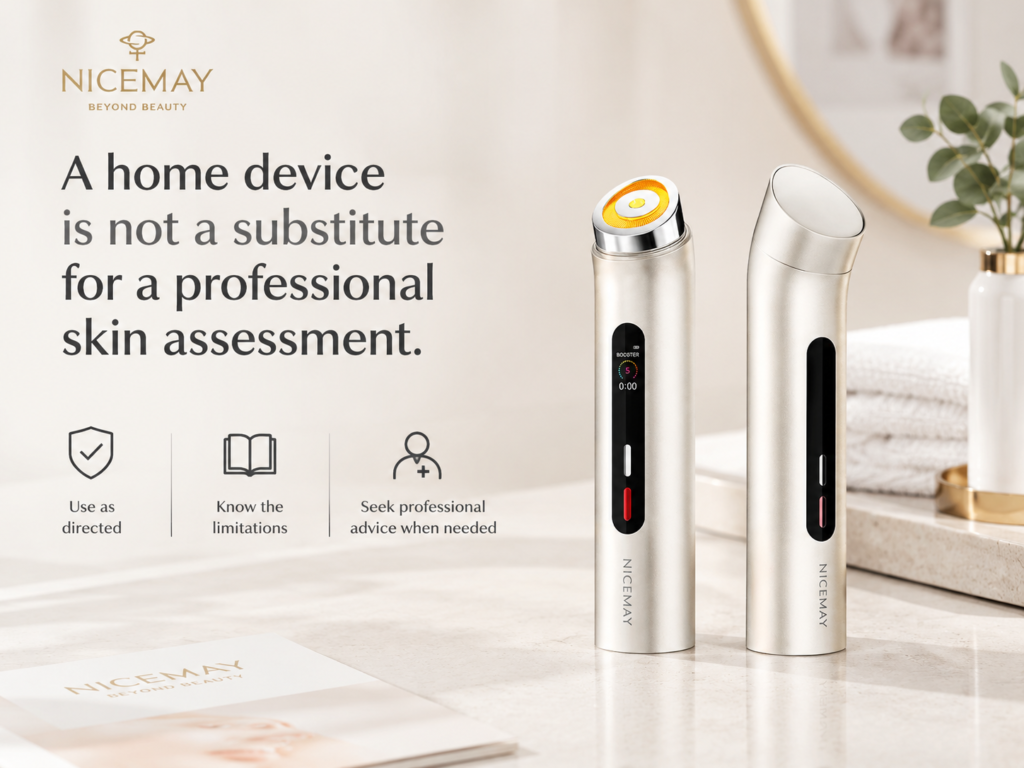
No. A consumer device is not a substitute for a professional assessment when one is needed. Product pages and user manuals should explain intended use, limitations, and relevant precautions.
This is not only a safety issue. Clear guidance also helps set realistic expectations and reduces the chance that customers will buy a product for a purpose it was never designed to serve.
For B2B buyers, the takeaway is to build customer education into the product plan. Packaging, product pages, frequently asked questions, and user instructions should all explain what the device is designed to do and when a user should seek professional advice.
How Should Brands Position At-Home Beauty Devices?
Brands should sell the value of the home-use experience without promising equivalence to professional procedures. Clear positioning can help customers understand why a device belongs in their routine and what distinguishes it from other products.
Which positioning messages are more credible?
A strong product position starts with a defined target customer, a clear intended use, and benefits that the product can support.
| Less suitable approach | More useful direction |
|---|---|
| “Replaces all professional facials” | “Designed to support a convenient home skincare routine” |
| “Professional results guaranteed at home” | Describe the product’s specific function and the evidence supporting it |
| “Works for every skin type” | Identify suitability and restrictions based on product-specific instructions |
| “Advanced technology means better results” | Explain the relevant product features and their purpose |
| “Instant and permanent lifting” | Use only performance claims supported by suitable evidence and permitted in the target market |
These examples are guidance for responsible positioning, not a substitute for reviewing applicable advertising and regulatory requirements.
How should brands choose a target customer?
Start by defining who is most likely to value the product. Possible customer groups include beauty enthusiasts who enjoy home skincare, consumers looking for a convenient routine, and customers interested in a specific device category.
For B2B brands, importers, distributors, and e-commerce sellers, the target audience also affects the product’s price positioning, packaging, product education, and sales channel.
A brand selling through premium beauty retailers may need a different product story and packaging approach from a brand selling through online marketplaces. Both should keep claims consistent with the device’s actual features and evidence.
Why should the product story focus on the user’s routine?
A realistic product story explains how the device fits into a customer’s day, how it is intended to be used, and what practical features make the experience easier.
For example, an easy-to-hold design, clear mode controls, straightforward cleaning, and convenient charging may help support usability. These are product attributes that can be assessed during development. They should not be confused with proof of a clinical outcome.
A brand can differentiate itself through a combination of design, usability, product education, and verified performance rather than relying on a single broad claim.
Which Product Features Matter Most for Home Use?
The best product design balances usability, appropriate safety controls, clear instructions, and the needs of the target market. A device should be evaluated as a complete consumer product rather than as a collection of technical features.
Which features influence the home-use experience?
Buyers can use the following checklist during sample evaluation.
| Product area | What to evaluate |
|---|---|
| Ergonomics | Is the device comfortable to hold and easy to maneuver? |
| Controls | Can users understand the modes and operating sequence? |
| Instructions | Are the steps, treatment time, cleaning, and precautions clear? |
| Maintenance | Can the device be cleaned and stored according to the instructions? |
| Power | Are charging, battery life, and power requirements suitable for the product concept? |
| Safety controls | Are relevant protective features included and verified? |
| Materials | Are materials suitable for the intended skin-contact and product use? |
| Packaging | Does the packaging protect the product and communicate the intended use clearly? |
| Quality control | Are the inspection criteria and acceptance requirements defined? |
The importance of each feature depends on the device category. For example, an RF device requires a different technical evaluation from a manual facial massage tool. Buyers should ask the manufacturer to explain which tests and controls are relevant to the selected design.
Should brands choose a multi-function device?
A multi-function device may offer a broader product concept, but it can also make development, testing, instructions, and marketing more complex.
Before combining functions, define what each one adds to the customer experience. Check whether the functions can be used together as intended, whether the instructions remain clear, and whether each advertised benefit has appropriate support.
A single-function product may be a better starting point when a brand wants a clear product story or needs to validate market demand before expanding its range. A multi-function product may suit a brand that has a defined customer need and can support the additional development and education requirements.
The right choice depends on the target market, budget, product strategy, and technical feasibility—not the number of functions alone.
How Can OEM/ODM Manufacturers Help Brands Develop the Right Product?
An OEM/ODM manufacturer can help translate a brand’s target customer and product requirements into a defined specification, sample, and production plan. The brand should still confirm the intended use, target-market requirements, claims, and acceptance criteria before launch.
What should a brand prepare before contacting a manufacturer?
A clear project brief helps the manufacturer understand the intended product and provide more relevant options.
Prepare the following information where possible:
- Target market: Which countries or regions will the product serve?
- Customer profile: Who will buy and use the device?
- Product category: Are you considering RF, LED, microcurrent, cleansing, massage, or another type?
- Intended use: What role should the device play in the customer’s routine?
- Key requirements: Which technical features, controls, materials, or design elements matter most?
- Order estimate: What is the expected first order quantity?
- Packaging: Do you need private-label packaging, custom artwork, or a retail-ready presentation?
- Launch timing: When do you plan to launch, and what testing or approval steps must happen first?
Not every detail needs to be finalized at the first discussion. The goal is to provide enough information to begin a structured product selection process.

What should the development process include?
A practical OEM/ODM workflow may include product selection, specification review, sample evaluation, design changes, documentation review, packaging approval, and mass-production quality checks.
The brand and manufacturer should agree on what constitutes an approved sample and which characteristics must remain consistent in production. If the product design or intended use changes, the parties should assess whether that change affects testing, instructions, or marketing claims.
The manufacturer should distinguish between existing product documentation and any additional testing or compliance work that may be required. Market-specific requirements should be confirmed before the product is placed on sale.
For a brand building a home-use beauty range, this process can also support future product planning. A clear product architecture makes it easier to explain the difference between cleansing devices, RF tools, LED products, and other categories without presenting them as interchangeable.
Explore our home-use beauty device range or contact NiceMay to discuss OEM/ODM options for your target market.
If you are comparing technologies before selecting an RF model, read our related guide: RF vs Microcurrent vs EMS: Which Facial Technology Fits Your Brand?.
For an overview of RF product types and buying considerations, return to our pillar guide: RF Beauty Devices at Home: How to Compare RF Machines, Devices and Facial Tools.
Frequently Asked Questions
Can at-home beauty devices replace professional facials?
Not completely. Some home-use devices may support selected skincare goals, but professional services vary widely and may involve assessment, techniques, or equipment that a consumer device does not provide. The comparison depends on the specific treatment and product.
Are at-home beauty devices as effective as professional devices?
There is no universal answer. Effectiveness depends on the technology, device design, treatment protocol, intended use, and quality of the supporting evidence. Brands should avoid making broad equivalence claims without suitable evidence for the products being compared.
Are home-use RF devices the same as professional RF machines?
Not necessarily. Devices may differ in design, output, controls, intended use, and operating instructions. Sharing the RF label does not establish that two products provide the same treatment or outcomes.
What should consumers check before buying a home-use beauty device?
Consumers should review the intended use, operating instructions, precautions, maintenance requirements, and any relevant suitability restrictions. They should also consider whether the device addresses their actual needs and whether professional advice is appropriate for their concern.
What should a brand look for in an OEM/ODM beauty device supplier?
Look for a supplier that can explain the product specification, sample-development process, quality-control procedures, available documentation, and customization options. Confirm what is already documented and what still requires testing or review for the intended market.
Conclusion: How Should Brands Position Home-Use Beauty Devices?
At-home beauty devices and professional facials serve overlapping but different roles. Home-use products can offer convenience and a consistent personal skincare experience, while professional services may provide assessment and treatment options beyond the intended use of consumer devices.
For beauty brands, the strongest approach is to define a clear product purpose, select technology that fits the target customer, verify product-specific claims, and provide practical instructions. Avoid promising that a home-use device can replace every professional treatment.
If you are planning a private-label or OEM/ODM beauty device, begin with your target market, product concept, technical requirements, and launch goals. These details help establish a more realistic path from product selection to a market-ready range.
My Role
NiceMay works with B2B customers exploring home-use beauty devices and OEM/ODM product development. Beauty brands, importers, distributors, retailers, and e-commerce businesses can discuss product selection, design preferences, and packaging requirements with our team.
Visit NiceMay to explore our product range or contact ken@sznicemay.com to discuss your project.
References
- U.S. Food and Drug Administration. Potential Risks with Certain Uses of Radiofrequency (RF) Microneedling – FDA Safety Communication. FDA
- Home-based devices in dermatology: a systematic review of safety and efficacy. Archives of Dermatological Research. Springer
- Development of Home Beauty Devices for Facial Rejuvenation: Establishment of Efficacy Evaluation System. Clinical, Cosmetic and Investigational Dermatology. PubMed Central