Red Light Therapy Masks: Benefits, Use Frequency, Cleaning and Buyer Checklist
Red light therapy masks are easy to understand at first glance: put on a wearable device and build a repeat-use skincare routine. For beauty brands, however, the purchase decision does not end with an attractive shape or a red glow. Customers also need clear expectations, a comfortable fit and instructions they can follow without guessing.
The gaps often appear after launch. A product page promises a simple routine, while the manual gives a different frequency. A support team recommends a cleaning wipe without knowing whether it suits the optical surface. A mask fits the sample tester but slips on other users. These issues belong in product development, not in improvised replies after complaints arrive.
Resposta direta: Selected red and near-infrared LED devices have evidence for improving certain facial-aging measures. Benefits are device-specific. Use frequency and cleaning must follow the exact model’s instructions. Brands should verify fit, eye protection, delivered output and a controlled commercial configuration before approving a private-label mask. 1 2
This guide is for beauty brands, skincare companies, importers, distributors and private-label teams. It is a product-selection and instruction-review guide, not an individual treatment plan. For the wider color framework, start with our LED light therapy colors and benefits guide. Here, the focus is the mask as a complete product system.
What are red light therapy masks, and what can they realistically do?
A red light therapy mask places light-emitting diodes in a wearable facial structure. Some designs combine visible red light with near-infrared, or NIR, which is not visible. The device may be flexible or rigid, but neither construction automatically establishes a better cosmetic result. The relevant question is what light reaches the intended facial areas under the supported wearing conditions. 4
A wearable format is not an efficacy claim
A mask may make a routine easier to repeat because it holds the emitters in a defined arrangement. That potential convenience should be assessed through fit and usability work. It does not mean every facial area receives the same exposure, or that hands-free operation proves superior performance. Nose shape, facial clearance, strap adjustment and movement can change the wearing condition.
For brands, a useful product concept connects an intended appearance concern with a practical routine. Fine-line appearance or skin texture may be relevant endpoints when supported by evidence. Permanent wrinkle removal, a home facelift or correction of pronounced laxity are different claims and should not be inferred from a red-light specification. A skincare device also should not inherit unrelated disease or hair-growth claims from research on other formats. 1 2
Do red light therapy masks work, and what should count as a benefit?
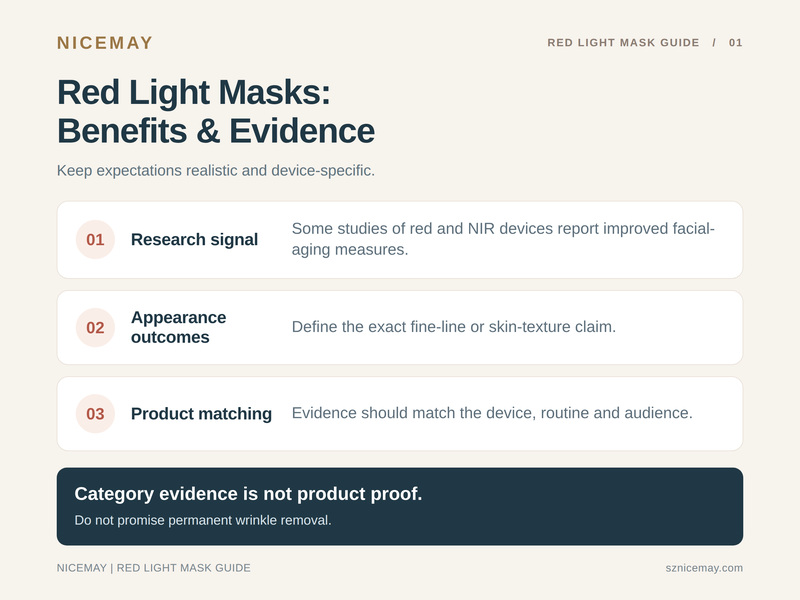
The evidence supports a qualified answer, not a blanket promise. A 2026 systematic-review abstract reported eight at-home LED studies involving 365 participants. It described improvements in several facial-aging measures, particularly with red and NIR devices, but also highlighted varying protocols, limited comparative evidence and underrepresentation of diverse skin phenotypes. It did not validate a Nicemay mask or identify one universally optimal routine. 2
A separate randomized, sham-controlled home-device study evaluated a 630 nm LED and 850 nm infrared-emitting system for crow’s-feet outcomes. Its findings belong to the tested device, participants and protocol. The study also discussed limitations and did not objectively establish all of the brightening impressions mentioned by participants. A brand should distinguish the measured endpoint from additional marketing interpretations. 3
Separate appearance outcomes from usability outcomes
Ask what the evidence actually measured: a wrinkle grade, an instrumental texture measure, a user perception or satisfaction with the routine. These are not interchangeable. Comfort and instruction comprehension can support a usability statement, but they do not prove a reduction in wrinkles. Likewise, a controlled optical report establishes output under its test conditions, not a clinical outcome.
Before-and-after images need consistent lighting, positioning, expressions and assessment. A small change in facial angle can make a mask seem more effective than the evidence supports. For a claim tied to a defined period, confirm how that period was evaluated and whether there was follow-up. Do not transform a study average into an individual guarantee or turn repeat-use instructions into permanent results.
How often should a red light therapy mask be used?
There is no single schedule that brands should copy across every red light therapy mask. The AAD advises regular use according to the directions supplied with the device, while noting that the time required varies and not everyone sees results. A familiar weekly frequency on another product’s website is not a validated instruction for a new private-label model. 1
Define the entire routine, not only the timer
The controlled instructions should address session length, repeat-use limits, mode selection and any initial or maintenance phase. Identify whether a sequence uses red alone, red with NIR or several modes in order. Clarify what happens after a session ends and whether restarting or changing modes resets the timer. These are product-development questions, not advice to combine extra sessions.
The same number of minutes can mean a different exposure when output, active wavelengths or fit change. Delivered optical exposure depends on measured irradiance over time and the geometry of use. A brand should therefore not copy a timer from a competing mask, increase output and assume the old schedule still applies. Nor should a pulsed mode be described only by its peak number when average delivery differs. 4
Review the routine across the manual, packaging, website, marketplace listing and customer-service script. If one channel says daily and another says several times weekly, users are left to resolve an engineering decision themselves. Translations and regional versions also need the same controlled basis. The goal is an understandable, evaluated routine, not the most intensive-looking schedule.
Version control matters after launch as well. A QR code should lead to the instructions for the purchased model and supported region, not merely the newest product in the range. Keep a way to identify the relevant hardware and manual revision when a customer asks for help. If a routine changes, evaluate the reason and affected versions before updating a website sentence. Older customers should not have to guess whether a new instruction applies to the device already in their hands.
What makes a mask comfortable enough for repeat use?
Fit is a commercial issue and a use-condition issue. A mask that slides, pinches or needs frequent adjustment may undermine the intended routine. Evaluate it with people who represent the proposed audience, not only the project team. Include face-shape variation and the supported head position, then record where clearance, strap pressure or movement becomes a problem.
Flexible and rigid masks need different checks
For a flexible mask, review the supported bending, recovery, strap attachments and contact surfaces. For a rigid mask, assess facial clearance, component placement and pressure points. Neither label proves that all faces fit. An attractive photograph of a single model cannot demonstrate comfort throughout the intended audience, and an excessively tightened strap is not an acceptable way to compensate for poor fit.
Assess fit with the intended eye-protection accessories installed. Removing a shield to improve comfort can change the evaluated configuration. Ask whether the user can identify the right side, adjust the straps and keep the mask positioned without watching a long demonstration. Record practical problems such as cable pull, controller access and the visibility of status indicators.
Give pilot users practical tasks: identify the correct orientation, attach the controller, adjust the straps, select the intended mode and stop the session. Observe where they hesitate or reinterpret an instruction. A concise manual should make these tasks understandable without a salesperson. Keep the tested accessories in the exercise, and record any attempt to remove or replace them. That feedback can identify a design or instruction gap before packaging is finalized; it is not clinical evidence that the mask improves skin.
Comfort testing should not become an unqualified safety claim. A person tolerating one sample does not prove that every production unit is safe or that every user is suitable. Define acceptance criteria and escalation for discomfort, unusual heat or unexpected skin responses. The final design still needs appropriate safety assessment under its intended and reasonably foreseeable conditions. 1 5
What should the instructions explain before and during a session?
Preparation should be written for the exact device. Confirm the approved facial preparation, accessory placement and allowed skincare combinations rather than assuming every serum helps light delivery. A skincare-and-mask bundle is a product system: its commercial instructions should identify what was evaluated together and what remains outside the supported routine.
Explain how to select the intended mode, recognize the session status, stop the device and respond to a fault. A brand should not rely on users to interpret a red glow as proof that all channels are active. NIR is invisible, and a multichannel device needs clearer status information than visual color alone. Positioning and accessories must reflect the conditions used in evaluation. 4
Avoid instructional images that contradict the manual. If the evaluated routine requires a particular posture or power condition, do not illustrate an unrelated activity or charging arrangement as normal use. Demonstrations, influencer briefs and support videos should use the same approved sequence. Convenience marketing should not introduce a different operating scenario without assessment.
How should a red light therapy mask be cleaned?
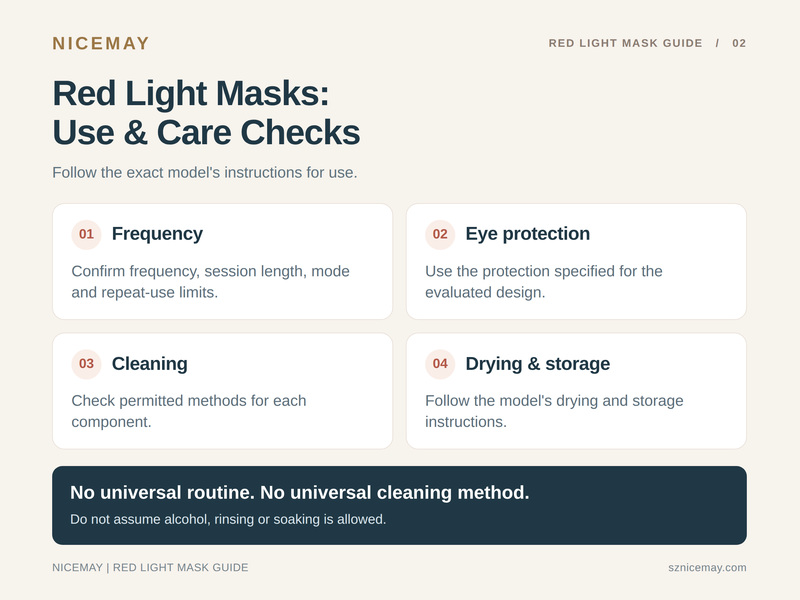
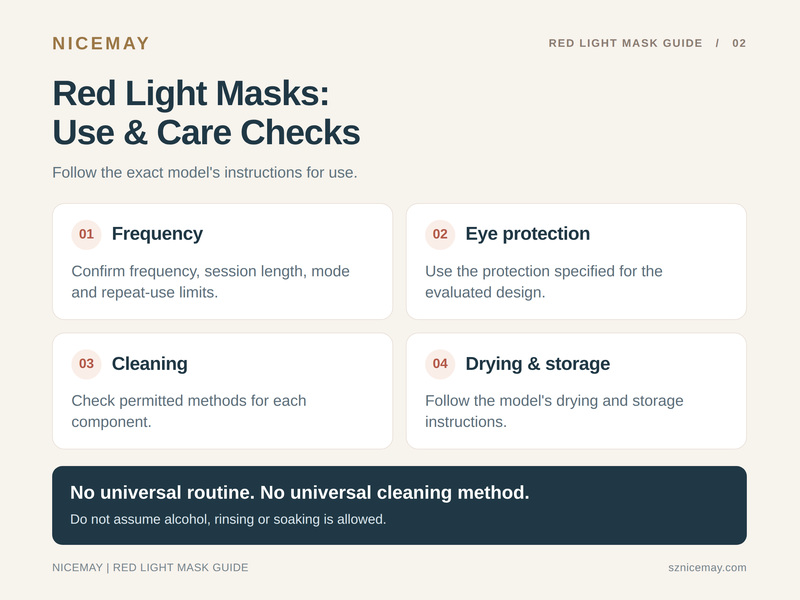
Cleaning must be model- and component-specific. Official instructions are not interchangeable: the CurrentBody Series 3 manual prohibits chemical or alcohol-based cleaning agents, while an Omnilux general FAQ describes limited alcohol use for stubborn stains. The latter is not a complete model-specific IFU. Neither source authorizes alcohol for a Nicemay mask. This difference is a reason to obtain the exact instructions, not to choose whichever method seems easier. 8 9
Audit care instructions separately for each component
A face-contact surface, optical window, removable strap and electronic controller may need different care. Permission to wipe one part is not permission to wet another. A silicone description does not establish compatibility with every solvent or wipe, and a protection rating should not be treated as blanket permission to rinse or immerse the assembled device. Ask the supplier to define the permitted method for each relevant component.
| Component | What the buyer should confirm |
|---|---|
| Face-contact and optical surfaces | Approved cloth or wipe; any permitted agent; residue and surface-compatibility limits. |
| Removable straps and eye accessories | Whether removal or washing is permitted; the exact method and replacement instructions. |
| Controller, cable and connectors | Separate cleaning permissions; electrical isolation and moisture restrictions. |
| Assembled mask | Allowed handling and drying; no assumed rinsing or immersion permission. |
| Storage accessories | Care and drying requirements before the mask is put away. |
The IFU should explain how to switch off and disconnect power before cleaning, which materials are allowed, what is prohibited and when use or charging can resume. Follow those exact directions rather than adapting a smartphone-cleaning method. Official manufacturer guidance illustrates why power separation and drying need explicit instructions, but its details remain specific to the product concerned. 8
Validate repeated cleaning, not just the appearance after one wipe. In a sample plan, inspect discoloration, tackiness, cracking, print wear, strap deterioration and any change in the optical surface. Link the cleaning method to the accepted material and assembly. If the method or material changes, review whether compatibility and relevant performance checks must be repeated before approving new instructions.
Write customer support answers from that approved care file. Questions such as whether a strap can be washed, whether a stain can be removed or whether a replacement wipe is allowed should have a defined answer or an escalation path. Staff should not improvise permission because two products both look like silicone. Give the care method a revision and identify the components it covers. If a requested method was not evaluated, say so and seek a technical decision rather than presenting it as safe by analogy.
Cleaning is not automatically disinfection
For an ordinary home-use concept, describe the validated care method without claiming that wiping sterilizes the mask. If a buyer proposes shared, demonstration or professional use, ask for a separately assessed hygiene plan for that setting. Do not turn household soil-removal instructions into a validated between-user disinfection process. The intended-use decision may change the product brief, instructions and evidence needed.
How should the mask be stored, inspected and maintained?
Storage instructions should address drying, supported handling and the conditions that protect the final assembly. Official mask guidance can include protection from moisture, direct sunlight and hot surfaces, but the exact conditions must come from the relevant product’s instructions. Do not infer an unrestricted storage range from a silicone exterior or copy another mask’s environmental limits. 8
Evaluate the retail packaging as a storage and transport system. Check whether it supports the intended shape without excessive folding, strain at connectors or trapped moisture. If a pouch is supplied, clarify when the mask can be put inside and how the pouch itself should be cared for. A premium box is not enough if normal packing strains the cable or compresses an accessory.
Define visible checks and a support route for damaged straps, lifting surfaces, abnormal light behavior, unusual heat or connector damage. Customers should not be told to improvise a repair or use an unapproved power supply. Replacement parts should have controlled identities and compatibility information, especially where an accessory affects fit, exposure or protection.
Warranty terms and service instructions should agree with the allowed cleaning and handling. A brand should not market a mask as effortless to maintain, then leave acceptable care undefined. Clear documentation also helps distributors distinguish wear, misuse and a possible product defect without diagnosing the customer’s skin or promising that every complaint is harmless.
Which safety questions should brands resolve before launch?
Red light is not ultraviolet light, but that does not make a wearable device automatically risk-free. The AAD describes possible discomfort and irritation, variable suitability and remaining questions about long-term effects. Review light-sensitive conditions, relevant medication concerns and skin-tone representation with the appropriate clinical or safety team. The article’s purpose is to define review questions, not prescribe a personal screening or treatment plan. 1
Eye protection belongs to the finished design
Confirm the exact eye-protection requirements, accessories and evaluated wearing condition. If instructions require particular protection, use what the device recommends; sunglasses are not a substitute. Closed eyes, eye openings or a shield’s appearance should not be presented as proof of adequate protection. The optical assessment should address the finished configuration and relevant exposure conditions. IEC 62471 provides a photobiological-assessment framework, not an efficacy certificate or proof that this mask has passed testing. 1 5
Combine optical review with the rest of the product system: electrical operation, charging, heat, mechanical durability, skin-contact materials and foreseeable misuse. Agree the applicable standards and market route with qualified specialists. For U.S. projects, establishment registration or device listing is not the same as approval, clearance or authorization. Do not use a factory document to imply a model-specific status it does not establish. 6
What belongs in a red light mask buyer checklist?
The buyer checklist should connect the physical mask, controller, accessories and instructions to one accepted commercial configuration. A supplier quote is a starting point, not an acceptance standard. Ask which version was tested, which version will ship and how any difference will be assessed. The following questions are especially useful for a wearable product; detailed optical methods remain in our LED specifications and claim-verification guide for brands.
| Review area | Buyer question | Useful acceptance evidence |
|---|---|---|
| Identidade do produto | Which exact SKU, hardware, firmware and accessories will ship? | Controlled specification and approved configuration record. |
| Wearing condition | Who can position the mask as intended, with the required protection? | Representative fit and instruction-comprehension results. |
| Optical delivery | What reaches the supported facial areas in each evaluated mode? | Spectrum and output reports with defined geometry and tolerances. |
| Use schedule | Do controls and all customer-facing instructions describe the same routine? | Approved IFU and a controller-function review. |
| Care and durability | Which component-specific methods remain compatible after repeated care? | Cleaning and handling validation linked to materials. |
| Claims and market | What evidence and market route support the proposed product wording? | Claim-to-evidence review and applicable regulatory assessment. |
| Production and service | How are changes, traceability, defects and replacements managed? | Acceptance plan, change rules and documented service scope. |
Avoid scoring samples only on brightness, mode count or how premium they feel. Compare declared values under the same measurement conditions, and distinguish a local maximum from an area average. Review each active channel where a combined number would hide the output relevant to the product claim. A mask with similar styling can still have a different spectrum, driver or timer. 4
The initial sample should be connected to an agreed production plan. Define checks performed per unit, by lot or periodically; specify traceability and approval for substitutions. A new silicone formulation, strap supplier, optical layer or LED bin may require more than a visual comparison. Agree when fit, care compatibility, output or safety must be reassessed, before a change is accepted for repeat orders.
For pilot approval, keep a configuration record with photographs, component identities, firmware revision and the matching instruction set. Record which units supported each measurement or usability review. Confirm how the approved sample is retained and how a later batch is compared with it. Visual matching alone cannot tell a buyer whether a substituted optical layer or driver preserves the agreed output. The comparison should use the acceptance methods written into the project, and exceptions should have a documented approval rather than a verbal assurance.
Assess the complete commercial package. Include approved accessories, retail packaging, languages, replacement parts, warranty handling and agreed verification work in the scope. A low unit quote can be misleading if the project later requires another controller, revised eye accessories or new manuals. Separate product cost, development effort and evidence requirements rather than assuming they are all included.
Channel requirements can change which mask is practical to launch. A DTC brand may need a concise wearing demonstration and an accessible support library. An Amazon seller needs an unboxing sequence that works without personal guidance and listing language consistent with the manual. Importers and distributors need versioned local-language documents and a clear replacement-part arrangement. These are usability and delivery requirements, not evidence of better skin outcomes. Discuss them before selecting the platform so that the quoted project covers the route to the customer, not just the assembled mask.
How can Nicemay help define a private-label mask project?
At Nicemay, we approach a mask project by connecting the brand brief to a configurable product platform and an agreed evaluation scope. Start with the intended market, retail price band, sales channel and appearance-focused positioning. Then identify the supported wearing format, desired controls, accessories and customer-care requirements. These decisions should precede a promise about how quickly every user will see results.

Use a published configuration as a starting point, not proof
Our published MR-2308 LED mask configuration lists amber 605 nm, red 630 nm, deep red 660 nm and NIR 850 nm, together with a flexible wearable format and customization options. These are attributed product-page details, not independent measurements or clinical verification. The public configuration does not list blue light, and it should not be presented as a blue-light acne mask. 7
For acne-oriented product questions, our blue-light acne evidence and home-use safety guide explains why the intended use and evidence need separate review. Adding a channel does not automatically transfer its benefits or leave the original safety assessment unchanged. A project should evaluate the revised configuration rather than borrow a claim from another wavelength or another mask.
We can use our LED OEM/ODM and private-label platform overview to frame the customization discussion. Logo, packaging, industrial design and electrical changes carry different development implications. A cosmetic color change is not the same as a changed LED layout or operating sequence. Agree the verification, documentation and sample-confirmation work before treating a customization as ready for production.
Our beauty device verification process provides a discussion point for prototypes, design evaluation and pilot preparation; it is not a claim that every model has completed every possible test. If the product brief requires a particular output, protection feature or cleaning method, define the evidence and acceptance criteria for that requirement. We do not recommend choosing a mask simply by its number of colors.
What should B2B buyers remember about red light therapy masks?
A credible red light mask combines realistic appearance expectations with controlled output, comfortable fit, appropriate protection and clear care instructions. For brands, the better platform is the one whose commercial configuration, evidence and production requirements can be checked—not the one with the loudest promise.
Share your target market, retail price band, preferred mask format and customization scope with Nicemay. We can discuss the product platform, sample-review priorities and documentation questions for an OEM/ODM brief without treating a published specification as a guaranteed cosmetic outcome.
What else should buyers know about red light mask use and care?
Do red light therapy masks remove wrinkles permanently?
Do not promise permanent wrinkle removal. Relevant studies address defined appearance measures under particular protocols. Whether a commercial mask can use an improvement claim depends on its evidence, configuration and intended market; repeated use is not proof that changes are permanent.
Can every red light mask be used daily?
No universal daily schedule applies. Follow the exact model’s evaluated instructions for frequency, session length and repeat-use restrictions. A brand should keep those instructions consistent across the controller, packaging, website and support materials rather than copy another product’s routine.
Is a higher LED count or stronger output always better?
No. Evaluate the measured spectrum, output, coverage, supported fit and evidence for the intended claim. LED count and electrical wattage do not replace treatment-surface measurements or establish a suitable routine. More output is not a reason to assume better results.
Can alcohol wipes be used to clean any LED mask?
No. Cleaning permissions differ by product and component. Do not infer alcohol compatibility from silicone construction or another manufacturer’s FAQ. Obtain the current IFU and the validated care method for the exact mask, optical surfaces and accessories before approving instructions.
Can a flexible mask be rinsed or soaked?
Only a verified instruction for that exact product can establish such permission. A wipe-clean surface is not an immersion instruction. Confirm the mask, controller, connectors and removable parts separately; do not assume the entire electrical assembly can be treated like a washable accessory.
Are closed eyes enough protection during a session?
Do not present closed eyes as an automatic substitute for evaluated protection. Follow the model’s specific instructions and use the recommended protective accessories when required. A buyer should verify the eye-area assessment and wearing configuration rather than rely on a generic red-light safety slogan.
Can a mask be bundled with any skincare serum?
Do not assume universal compatibility. Define which preparation, skincare products and sequence were assessed together. The bundle instructions should reflect that evaluation, including any exclusions. A commercially attractive pairing is not evidence that every ingredient improves light delivery or outcomes.
What should brands request before approving a private-label mask?
Request a controlled configuration, output and safety evidence relevant to the intended use, the current IFU, component-specific cleaning permissions and an agreed production acceptance plan. Confirm the claims, target market, replacement parts and change-control rules before approving customer-facing content or repeat orders.
Referências
[1] American Academy of Dermatology: Is red light therapy right for your skin?
Return to text
[2] Das et al. 2026: Efficacy and Safety of At-Home LED Photobiomodulation for Facial Rejuvenation, systematic review
Return to text
[3] Park et al. 2025: Clinical study to evaluate the efficacy and safety of home-used LED and IRED mask for crow’s feet
Return to text
[4] Hadis et al. 2016: The dark art of light measurement, accurate radiometry for low-level light therapy
Return to text
[5] IEC 62471:2006: Photobiological safety of lamps and lamp systems
Return to text
[6] U.S. FDA: Important Reminders about Registration and Listing
Return to text
[7] Nicemay: MR-2308 LED Face Mask, published product configuration
Return to text
[8] CurrentBody: LED Face Mask Series 3, Product User Guide and Manual
Return to text
[9] Omnilux: Official Help Center, cleaning FAQ
Return to text
keywords: red light mask benefits; benefits of LED face mask; infrared face mask benefits; how often to use a red light mask; how to clean red light mask; LED mask buyer checklist