Blue Light Therapy for Skin: What Does Blue Light Do for Acne and Is It Safe at Home?
Blue light therapy for skin attracts buyers who want a practical answer to a familiar problem: can a light-based routine improve acne without turning home care into a complicated treatment? For beauty brands, the challenge is different. A blue setting can be easy to add to a product description, but much harder to connect to reliable evidence, appropriate warnings and a defensible market claim.
Direct answer: Selected home-use blue and blue-red LED protocols have evidence for improving mild-to-moderate acne. Results are device- and protocol-specific, not a guarantee for every blue-light product. Home-use safety depends on the finished design, exposure, eye protection, user suitability and instructions; blue light is not automatically risk-free. 1 2 3
This guide is written for beauty brands, skincare companies, importers, distributors and private-label teams. We explain what blue light does, what the studies can support and what a brand should check before selecting an acne-oriented LED concept. It is not an individual treatment plan. For the broader platform framework, see our guide to red light and LED light therapy for skin.
What is blue light therapy for skin, and how does it work?
A blue LED device emits a band of visible light. In the 2025 review of portable and home-use acne devices, the studied blue wavelengths ranged from 414 to 445 nanometers. These are research examples, not a universal purchase specification or recommended treatment range. A product that appears blue may have a different peak wavelength, spectral width and output from the devices used in those trials. 1
The acne-related mechanism involves naturally occurring porphyrins
Cutibacterium acnes, a bacterium involved in acne, produces light-sensitive compounds called porphyrins. Under suitable illumination, these compounds can participate in photochemical reactions that generate reactive species harmful to the bacteria. This explains why certain blue wavelengths are investigated for acne. It does not prove that every device labeled antibacterial delivers a clinically meaningful benefit on a person’s skin. 4
Acne is not simply a dirty-skin problem or the presence of one bacterium. Follicular plugging, sebum production, hormonal influences and inflammation also contribute. A mechanism directed at one part of that process should not become a claim to eliminate every cause of acne. Nor does a laboratory finding that bacteria respond to light establish that a mask sterilizes skin or prevents every future breakout. 4
Ordinary blue LED use is not clinical photodynamic therapy
Clinical photodynamic therapy, or PDT, combines a photosensitizing agent with an activating light source. A home LED device used without that agent is a different intervention. Brands should not borrow PDT outcomes, clinic photographs or professional procedure instructions to substantiate a standard home mask. Likewise, blue LED, ultraviolet exposure, IPL and laser procedures are not interchangeable because they all involve light. 4
Does blue light therapy for acne really work at home?
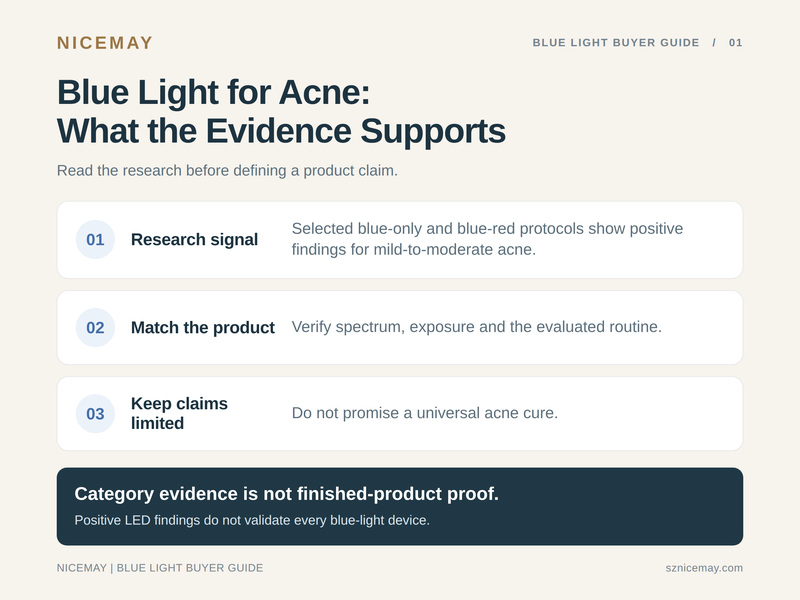
The useful answer is a qualified yes for selected studied approaches, not a universal promise. A 2025 systematic review and meta-analysis in JAMA Dermatology included six randomized clinical trials and 216 participants with mild-to-moderate acne. The interventions included blue-only, red-only and combined blue-red devices. Compared with controls, the pooled findings favored LED treatment for several lesion-count and investigator-assessment outcomes. 1
The authors reported that improvements were typically noted after four to twelve weeks of use in the included studies. That observation helps explain why an immediate clear-skin promise is inappropriate. It is not a four-week guarantee, a universal session schedule or evidence that a new private-label model will reproduce the same timeline. The review also included studies with very different durations and treatment conditions. 1
Positive category evidence is not finished-product validation
The review identified moderate-to-high heterogeneity arising from differences such as light source, fluence and treatment duration. Its authors explicitly cautioned that the findings might not generalize to other devices on the market. A brand therefore needs more than a citation to that review: it needs a justified connection between the proposed claim and the actual commercial configuration, including its spectrum, delivered exposure and evaluated routine. 1
Do not take a pooled treatment-versus-control difference and place it on a box as the percentage of acne a Nicemay device removes. A combined result is not a blue-only result; a group average is not a guaranteed individual outcome. Before-and-after photographs also need consistent lighting, positioning and assessment. Attractive images cannot substitute for a suitable comparison, defined endpoints and adverse-event reporting. 1
A useful evidence file identifies what changed and how it was measured. Was the main outcome an inflammatory lesion count, an investigator rating or a user satisfaction score? Was the comparison sham light, no light or an active treatment? Were other skincare products allowed? Record these differences before using the term clinically tested. A satisfaction survey may establish that users liked a routine, but it cannot demonstrate the same outcome as a controlled acne study. Adherence and withdrawals also matter: a favorable result among consistent users may not describe everyone who starts the routine. 1
Separate short-term improvement from maintenance and prevention. A study that measures lesions at the end of a treatment period does not necessarily show how long the change lasts after use stops. A brand considering a maintenance claim should ask for follow-up that addresses that question, rather than converting repeated-use instructions into permanent prevention. The same discipline applies to trial demographics: a result from a small defined group should not become an all ages, all skin types claim. 1
Research findings and clinical guidelines answer different questions
The AAD’s 2024 acne-guideline announcement stated that available evidence was insufficient to develop recommendations for procedures including laser and light-based devices. The positive home-LED review was published in 2025 and addressed a narrower set of interventions. These statements should not be collapsed into either blue light never works or dermatologists now recommend every home LED mask. A newer review does not, by itself, revise an official guideline. 1 5
Which acne concerns fit the evidence, and which need a different approach?
Most of the home-device evidence discussed here concerns mild-to-moderate acne, not every condition sold under the language of blemishes. Study eligibility matters: participants, acne severity, lesion types, skin characteristics and other treatments all influence what a result can support. A brand should define the intended audience before choosing an image of perfectly clear skin or writing a statement about stubborn acne. 1 4
| Concern or proposed claim | How brands should interpret the evidence |
| Mild-to-moderate acne | Relevant home-LED research exists; match the finished configuration and protocol. |
| Inflammatory lesions | Review lesion-count outcomes rather than a generic clear-skin score. |
| Blackheads and whiteheads | Some pooled noninflammatory outcomes improved; this does not establish direct pore-unclogging by blue light. |
| Painful nodules, cysts or scarring acne | Do not extend mild-to-moderate studies into a home-device treatment promise. |
| Dark marks after acne | Lesion improvement is not proof of pigmentation correction. |
| Permanent prevention of future breakouts | Requires separate long-term evidence; not established by short treatment studies. |
The 2025 analysis reported improvement in both inflammatory and noninflammatory lesion outcomes across its selected LED trials. That should not become a blanket blue light clears blackheads message. The pooled interventions included different wavelengths and combinations, and acne has several interacting causes. Product teams should distinguish an observed clinical endpoint from an unsupported physical story about opening pores, extracting plugs or controlling all sebum production. 1 4
Persistent, painful or scarring acne warrants assessment by a qualified clinician rather than a stronger intensity setting. A brand should not instruct users to abandon prescribed care or diagnose the severity of their condition through a color menu. Customer-service scripts should provide an appropriate escalation route, especially when a complaint describes worsening lesions, significant discomfort or unexpected skin changes. That is a product-responsibility issue, not a substitute for medical practice. 5 3
Is blue light better than red light or a blue-red combination for acne?
Blue and red light have different research rationales. Blue acne research commonly examines porphyrin-related photochemical effects; red light is investigated for inflammation-related and other biological effects. Combined blue-red protocols have produced positive findings, and the 2025 review described encouraging combination results. However, that does not establish that any mask with two colors outperforms every single-channel device. 1 4
A fair comparison needs comparable users, endpoints and treatment conditions. When a combination study differs in dose, duration or control group, its outcome cannot isolate the contribution of blue, red or the combination itself. Brands should ask whether the modes operate simultaneously or sequentially, what each channel delivers and whether the supporting evidence evaluated that exact pattern. 1 6
Purple-looking light may simply be red and blue emitters operating together. A purple label does not identify the wavelengths or their relative contribution, and it does not establish a separate scar-repair benefit. Our LED light therapy colors and benefits guide explains mixed-color labels in more detail. For an acne-oriented brief, prioritize the measured channels and evidence rather than the visual appeal of a seven-color menu. 1 6
Is blue light therapy safe at home?
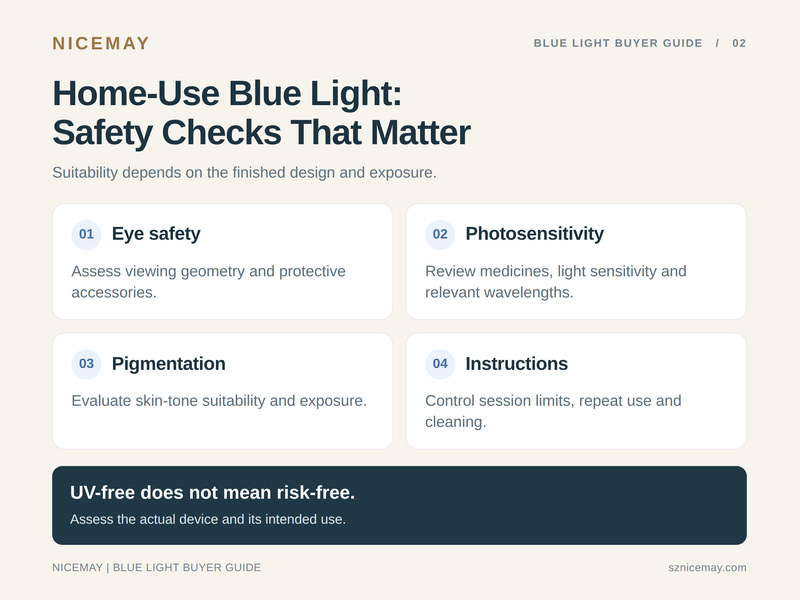
Safety needs a finished-product answer, not a reassurance based on the word LED. In the 2025 home-device review, no severe adverse reactions were reported in the included studies, while reported effects included dryness, erythema and discomfort or pain. These relatively small studies do not establish lifetime safety, safety for every user or the risk profile of an unrelated product with a different spectrum or exposure. 1
Eye safety is an optical-design issue
IEC 62471 provides a framework for assessing photobiological hazards from lamps and lamp systems, including LEDs. The assessment involves the emission, measurement conditions and exposure; it is not a clinical-efficacy certificate. For a facial device, the laboratory must consider the final configuration and intended use, and identify the standards and editions that apply to that model and destination market. 2
Evaluate normal wear, foreseeable displacement, direct viewing and light leakage around eye openings. If protective accessories are required, assess their fit and optical performance with the device. An eye-shaped opening, a silicone surround or a lifestyle image with closed eyes does not by itself prove adequate protection. Instructions and included accessories should reflect the assessed operating conditions rather than leave the precautions to customer guesswork. 2 3 7
Photosensitivity and pigmentation need separate attention
Light-sensitive conditions and medicines that increase photosensitivity can affect suitability. A general safe for sensitive skin claim does not answer those questions. Brands should obtain qualified input for exclusions and warnings, including when users should seek advice before starting. Avoid copying a medication list from another product: the final instructions need to match the device, spectrum, intended audience and relevant safety assessment. 3
Photosensitivity is wavelength-dependent. A review of drug-induced photosensitivity explains that many reactions primarily involve UVA, although some involve other bands, including visible light. That is why a general warning about photosensitizing medicines should not be turned into an unverified blue-light contraindication list. Obtain qualified review of the actual spectrum and user information; do not advise customers to stop or change a medicine to make a device routine possible. 8
Visible blue light can also be relevant to pigmentation. Controlled human research has reported pigmentation responses to blue-violet exposure, with effects varying by skin phenotype and exposure conditions. Such experiments are not a universal estimate of harm from home acne devices, but they are a reason not to promise that blue light is suitable for every skin tone or automatically improves post-acne dark marks. Evaluate those questions specifically. 9
A blue LED skincare exposure should not be equated with everyday screen use or used to borrow claims about mood, sleep or seasonal conditions. Those are different exposure patterns and intended uses. Likewise, visible light is distinct from UV, but UV-free is not synonymous with risk-free. Verify the actual spectrum and keep safety wording tied to the tested product rather than a broad color category. 2 6
Comfort and usability belong in the safety plan
Check accessible temperatures, power and battery behavior, skin-contact materials, cleaning compatibility and the clarity of controls. Test how the product behaves after interruption, restart or repeated mode changes. The manual should state what to do if significant discomfort, persistent irritation or visual symptoms occur. A comfortable first sample is helpful feedback, but it cannot replace optical testing or demonstrate tolerability throughout the intended routine. 2 3
How often should a home blue-light device be used?
There is no universal blue-light schedule that brands should copy across products. The studies used different devices, wavelengths, output levels and routines. A session lasting the same number of minutes can deliver a different exposure when irradiance, working distance, pulsing or fit changes. Use frequency should come from the evaluated finished product and approved instructions, not a generic online chart. 1 6
More exposure is not automatically more benefit. Product teams should control session length, allowable repetition and mode changes, then ensure the labeling describes that sequence accurately. If red and blue can be selected separately, explain whether the evaluated routine uses one channel, both channels or a defined sequence. Do not encourage users to stack every color or increase the timer in pursuit of faster clearing. 1 6
Consider what happens when a user presses blue, then red, then restarts the device. Does the controller limit the complete session or only the current mode? Does switching channels reset the timer? These are engineering and instruction questions to resolve during evaluation, not a recommended user sequence. A routine described as simple can still create unintended cumulative exposure if controls and labeling disagree. Evaluate foreseeable behavior and ensure the approved instructions are reflected in the operating logic.
Skincare compatibility also needs evidence and clear instructions. A brand should not assume every serum improves light delivery or that every acne active can be used in the same routine without additional review. Specify any required preparation, approved accessories and material-compatible cleaning method. A skincare-and-device bundle is a product system: its instructions should explain what was evaluated together and what was not. 6
Which blue-light specifications should a brand verify before sourcing?
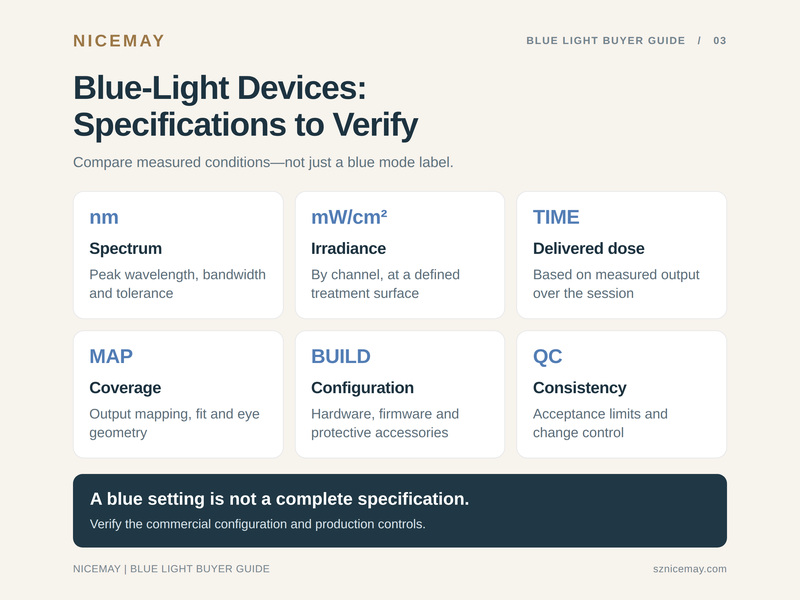
A blue setting is a mode name, not a specification. Ask for the final device’s peak wavelength, bandwidth and tolerance, with the spectrum measured through its actual optical assembly. For a mixed mode, request the identity and contribution of each channel. Component data and a bright sample are not substitutes for a report that describes the complete product under defined operating conditions. 6
| Blue-light procurement check | What should be recorded |
| Spectrum | Peak wavelength, bandwidth, tolerances and final optical assembly. |
| Channel-specific irradiance | mW/cm² at a defined distance, orientation and treatment surface. |
| Exposure and timing | Measured output over time; pulse details where relevant; controlled session sequence. |
| Coverage and eye geometry | Mapped output, intended fit, excluded areas and eye-safety assessment conditions. |
| Productidentiteit | Approved hardware, firmware, controller, power supply and protective accessories. |
| Change control | Approval and reassessment rules for changes affecting output, fit or instructions. |
Do not compare a local peak measurement with another supplier’s area average. Record the instrument, calibration status and test geometry. Separate electrical input watts from optical irradiance at the treatment surface. For combined devices, a total output figure can hide the fact that the blue channel contributes only a small fraction of the quoted number. A useful comparison identifies both the measurement and the question it answers. 6
An approved sample should be linked to a controlled specification and an agreed acceptance plan. Specify which checks occur on every unit, by lot or periodically, and which changes require approval before repeat orders. A different LED bin, diffuser, driver or timer may alter the evidence match even if the shell looks identical. Sample similarity is not the same as repeatable measured output.
The evidence package should also identify test limitations. A report measured at one position may not describe the curved areas of a mask; a report for one intensity may not cover all selectable levels. Check whether the assessed protective accessories, controller and power supply are the same versions that will ship. Where a changed configuration falls outside the existing evidence or safety assessment, agree the additional work before purchase rather than relying on a supplier statement that it is almost the same. 6 7
How should brands describe acne benefits and verify market status?
Separate educational discussion of acne research from product advertising. This article can explain what investigators studied; it does not authorize any Nicemay product to claim acne treatment. Calling a device a beauty tool, using blemish language or adding a not medical advice disclaimer does not settle its classification. The intended use, product presentation and destination-market requirements still need qualified assessment. 10
In the United States, FDA establishment registration and device listing do not mean approval, clearance or authorization. A registration certificate is not a substitute for verifying the actual model and its permitted intended use. If a supplier claims FDA clearance, examine the applicable record and labeling rather than assuming the status covers every wavelength, accessory, private-label modification or acne claim. 11
For Europe, the United Kingdom, Australia, Japan and South Korea, assess the product under the relevant local rules with qualified support. Electrical or EMC documentation may answer important safety questions, but it does not demonstrate acne efficacy or automatically authorize medical claims. A document accepted for one territory or configuration is not evidence that the same advertising can be used everywhere.
Avoid guarantees such as clears all acne, prevents future breakouts permanently or safely replaces prescription treatment. Also review softer-sounding statements such as clinically proven, safe for all skin tones and dermatologist approved. Each needs a specific, supportable meaning. Keep the website, packaging, marketplace listing, influencer brief and distributor materials consistent with the evidence and authorized intended use rather than letting stronger claims appear in a secondary channel. 1 5 11
How can Nicemay help evaluate a blue-light or blue-red product brief?
At Nicemay, we start with the product role: target market, intended user, main skin concern, sales channel, retail price band and expected quantity. A portable blemish-care concept and a wearable multi-channel mask raise different design and validation questions. We would evaluate the required configuration before treating blue as a simple extra feature or quoting a claim-led concept as ready for launch.
Channel fit matters, but it should follow the intended-use decision. A DTC brand needs education that explains realistic outcomes and exclusions without a salesperson. An Amazon seller needs listing language, accessories and instructions that remain consistent across variants. A distributor needs a controlled model and a clear territory-specific document plan. A skincare bundle needs an evaluated compatibility story. None of those commercial choices removes the need to substantiate acne-related claims; they determine where customers may encounter confusion and where the brand must make the boundaries clearer.
Our LED OEM/ODM and private-label platform page provides a starting point for that discussion. It should not be read as proof that every listed model includes blue light or holds acne-related authorization. Availability, customization feasibility, supporting evidence and target-market documentation should be confirmed for the proposed project rather than inferred from a general manufacturing page. 12
For example, our published MR-2308 LED mask configuration lists 605 nm amber, 630 nm red, 660 nm deep red and 850 nm near-infrared. Blue is not listed in that configuration. We would not present it as a blue-light acne mask or transfer combined blue-red trial results to it. A proposed blue-channel change requires feasibility and impact review, not a new name on the color menu. 13
Compare quotations on the same project scope. A ready-to-brand configuration, a packaging-only change and a new blue-channel design can carry different engineering, testing and documentation needs. Ask which measurements and reports are included, who commissions additional work and how a failed acceptance result will be handled. Also agree what supports future production lots, not just the first sample. A low unit price is not a complete comparison if one quotation excludes the verification needed for the proposed intended use. The practical goal is a platform whose commercial brief, evidence plan and manufacturing controls can be aligned before investment.
Before moving toward production, agree the scope of design review, optical measurement, protective accessories, labeling and sample acceptance. Our beauty device verification process is a useful entry point for discussing these stages, not evidence that every requested test has already been completed. Freeze the approved configuration and assign responsibility for change review, complaint handling and repeat-order consistency.
Share your target market, intended LED use, retail price band and preferred format with Nicemay to discuss a suitable project scope. An acne-oriented launch should include the evidence and market-review work in its budget and schedule, rather than treating them as paperwork to add after a sample is approved.
What should brands remember about blue light therapy for skin?
Blue light has a credible acne-related research rationale, but a blue setting is not a complete product proposition. Build the offering around a defined audience, measured configuration, appropriate safety, supportable claims and controlled manufacturing—not a color label or universal clear-skin promise.
What else should buyers know about blue-light acne devices?
What does blue light do for skin?
In acne research, certain blue wavelengths are studied for porphyrin-related photochemical effects involving C. acnes. That mechanism is not proof of general anti-aging, skin sterilization or guaranteed acne clearance. The claimed outcome still needs evidence for the finished configuration. 4
Does blue light therapy work for acne at home?
Selected home-use blue and blue-red LED approaches have positive evidence for mild-to-moderate acne. Results vary, and the 2025 review warns against generalizing to other devices. Match the actual spectrum, exposure, routine and intended claim rather than assuming all blue modes are equivalent. 1
Can blue light help blackheads or acne scars?
Some reviewed LED trials reported noninflammatory lesion improvements, but that does not establish a universal blue-only blackhead claim. Scar improvement is a different endpoint from acne lesion reduction and needs separate evidence. Do not infer either benefit from the color menu alone. 1 4
Is blue light therapy safe for every skin tone?
Do not assume universal suitability. Pigmentation research, photosensitivity, eye safety and the device’s exposure conditions all matter. Experimental blue-violet pigmentation findings do not quantify risk for every home mask, but they support reviewing skin-tone suitability rather than promising no pigment effects. 2 9 3
How many minutes should a blue-light session last?
Follow the evaluated instructions for the actual model. Time alone does not define exposure, and published routines differ in output, distance and mode sequence. There is no generic minute count that brands should apply to every blue-light device. 1 6
Is purple light the same as a validated blue-red acne protocol?
No. Purple may describe a visual mixture of red and blue emitters. It does not specify wavelengths, channel output or treatment sequence. A validated combination requires those conditions to match the evidence, not merely a purple-looking glow. 1 6
Does FDA registration prove that an acne device is cleared?
No. Establishment registration and device listing do not mean approval, clearance or authorization. Verify the device-specific record and intended use; do not treat a registration certificate as permission to advertise acne treatment. 11
Does Nicemay’s MR-2308 include blue light?
The published MR-2308 configuration lists amber, red, deep red and near-infrared, not blue. A blue-light project should be discussed as a configuration and feasibility question. Do not assume the existing model is an acne device or that adding blue requires no further assessment. 13
Bronvermeldingen
Voetnoten
2.IEC 62471:2006: Photobiological safety of lamps and lamp systems
3.Cleveland Clinic: LED Light Therapy ↩
4.Akuffo-Addo et al. 2024: Visible Light in the Treatment of Acne Vulgaris, systematic review ↩
5.American Academy of Dermatology 2024: Updated guidelines for the management of acne ↩
6.Hadis et al. 2016: The dark art of light measurement, accurate radiometry for low-level light therapy ↩
7.ICNIRP 2020: Light-Emitting Diodes, Implications for Safety ↩
8.Di Bartolomeo et al. 2022: Drug-Induced Photosensitivity, clinical types and mechanisms ↩
9.Duteil et al. 2014: Differences in visible-light-induced pigmentation according to wavelengths, clinical research abstract ↩
10.U.S. FDA: How to Determine if Your Product is a Medical Device ↩
11.U.S. FDA: Important Reminders about Registration and Listing ↩
12.Nicemay: LED OEM/ODM and private-label platforms ↩
13.Nicemay: MR-2308 LED Face Mask, published product configuration ↩