
CUSTOMER CASE STUDY · LED BEAUTY DEVICE OEM & ODM
From an LED Platform to a Market-Ready Phototherapy Brand Product
How Nicemay developed the MR-2308 LED mask platform into Blyss Helio—a branded, hands-free phototherapy product designed to bring controlled light therapy closer to the user’s daily routine.
お客様:
Blyss Care
完成品:
Final product: Blyss Helio Pro™
元のプラットフォーム:
Nicemay MR-2308 LED Face Mask
Core problem:
Stationary panel treatment, changing treatment distance, and separate eye protection
Core solution:
Face-contouring wearable structure with distributed LEDs and integrated eye shields

プロジェクトについて
Turning a Professional-Grade LED Platform into a Consumer-Ready Product
Large-panel LED therapy systems use a remote light source. The user sits or lies in front of the panel while the face remains within a recommended treatment area. This format can work in a dedicated treatment space, but it creates several product and usage constraints:
•
The user must remain close to the intended treatment position.
•
The face is not always the same distance from the panel, especially around the cheeks, jawline, and sides of the face.
•
A flat light source does not naturally follow the three-dimensional shape of the face.
•
The user may need separate goggles or eye protection.
•
The user cannot easily read, use a phone, move around, or continue another activity during the session.
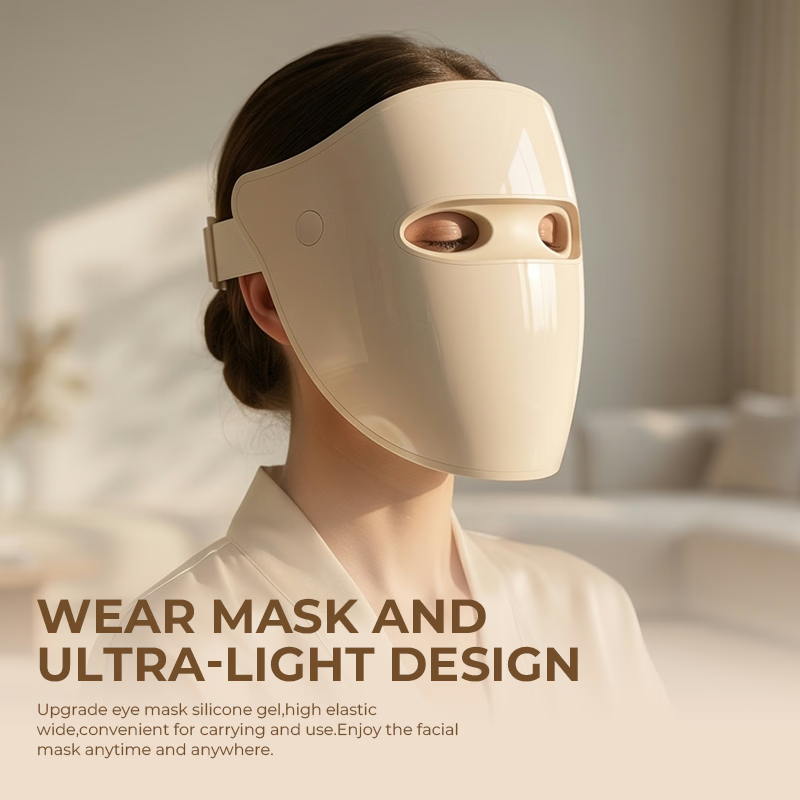
The MR-2308 platform was designed around a different use case: bring the light sources onto a flexible mask that follows the face, controls the treatment distance, and allows the user to wear the device without holding it in position. Nicemay’s product page describes the platform as using 220 distributed LED beads, a flexible face-contouring structure, integrated silicone eye shields, and hands-free use.
美容ブランドにとって、OEM/ODMパートナーの価値は、単に製品を製造することにとどまりません。製品技術、ブランドポジショニング、ユーザー体験、パッケージング、そして生産体制を、一貫性のある発売計画に統合する能力こそが、その価値なのです。
課題
OEMプロジェクトの背景にある4つの具体的な制約
このプロジェクトでは、光、顔の形状、目の保護、そして家庭での繰り返し 使用がどのように相互作用するかについて、単なる新製品名にとどまらない、技術的な解決策が求められていた。.
01 / A flat panel does not follow the face
With a conventional panel, the light source remains in one flat plane while the face curves away from the center. The nose, cheeks, jawline, and face edges are therefore not presented to the light at the same distance or angle. When the user moves forward, backward, or slightly to one side, the exposure geometry changes again.
The commercial issue is simple: the user may not know whether the face is positioned correctly, and the brand must explain a treatment setup that depends on distance, posture, and alignment.
02 / The light had to move closer to the skin without making the experience uncomfortable
A remote panel requires a gap between the LEDs and the face. Increasing that gap makes the product less dependent on close contact, but it also makes positioning more important. Bringing the LEDs closer can improve coverage and make the device more compact, but the mask must then manage heat, eye exposure, facial clearance, and comfort.
The MR-2308 product page lists an intensity range of 43 ± 5 mW/cm² and describes a moderate treatment distance, distributed light sources, and a flexible fit. These specifications need to be confirmed against the final Blyss Helio configuration before publication.
03 / Eye protection could not become another piece of equipment the user had to manage
A stationary panel often places the user in front of an exposed light source. Separate goggles may be required, which adds another item to the routine. Goggles can move, press against the face, interfere with glasses, or make the product look more like a clinic setup than a simple home-care device.For a wearable product, eye protection has to be designed into the mask rather than treated as an accessory added at the end of the project.
04 / The product had to support movement without losing the treatment experience
The customer-facing goal was not simply to make a mask that could be worn. It was to make a product that could be worn during a short, repeatable home routine. The mask needed to stay in place, distribute its weight across the face, reduce pressure around the nose and forehead, and leave the user’s hands free.
Blyss Care’s product page positions Helio around lightweight silicone, full mobility, hands-free use, USB-C charging, and 10–20 minute sessions.[2] These are important conversion details because they answer the buyer’s practical question: “Can I realistically keep using this product?”

当社のソリューション
実績あるLEDプラットフォームから、包括的な製品システムへ
01 / Replace the flat treatment plane with a face-contouring mask.
Instead of asking the user to position the face in front of a remote panel, the MR-2308 platform brings the light sources onto a flexible mask that follows the facial contour. This changes the positioning problem from “keep your face at the correct distance from the panel” to “put on the mask and adjust the strap.”
The mask geometry places the LEDs around the face rather than on one distant plane. This helps reduce the variation in distance between the light sources and the treatment areas. The final uniformity must still be verified through the client’s optical and safety testing, but the product architecture directly addresses the original panel limitation.
02 / Distribute the LEDs along the facial coverage area
The MR-2308 platform uses 220 high-energy LED beads distributed across the mask. The objective is not simply to increase the LED count. It is to place the light sources across the areas that a flat panel illuminates from a distance: the central face, cheeks, lower face, and perimeter of the treatment area.
This distribution gives the brand a stronger technical explanation than “more lights.” It explains why the product can provide closer, more consistent coverage in a wearable format.
03 / Integrate eye protection into the mask structure
The MR-2308 platform uses built-in silicone eye shields to block direct light exposure. This removes the need to position a separate pair of goggles before every session and keeps the eye-protection function connected to the mask itself.
For Blyss Helio, the commercial value is practical: the user can put on one device, select a mode, and begin the session. The product page also lists protective goggles as part of the product features, so the final customer-facing wording should distinguish between the integrated eye-shield structure and any additional goggles included in the package.
04 / Use flexible silicone and adjustable retention to manage fit
A rigid shell can create pressure at the nose, forehead, and cheekbones when the face shape changes. The MR-2308 product description instead emphasizes an ultra-light flexible structure, professional silicone eye shields, and an adjustable headband that adapts to different face shapes.
This is not only a comfort decision. Fit affects the repeatability of the treatment distance. If the mask shifts or lifts away from the face, the optical geometry changes. A flexible body, an adjustable strap, and a controlled contact area help the user reproduce the same basic position from one session to the next.
05 / Keep the interaction simple enough for hands-free use
The MR-2308 platform uses one-touch operation and intelligent voice prompts. This reduces the number of controls the user has to see or handle once the mask is worn. The customer-facing product can therefore communicate a simple sequence: put on the mask, select the mode, and complete the session without holding a panel in front of the face.
Blyss Care lists smart-touch control, auto shut-off, and three intensity levels for Helio. These details turn the hands-free claim into a concrete user flow instead of a generic lifestyle statement.
材料の選定
プロジェクトの製造に適した材料の調達
素材の選定にあたっては、以下の4つの要件を同時に満たす必要がありました。すなわち、マスクが顔に密着した状態でも柔軟性を保つこと、LEDの形状が安定していること、繰り返し使用しても電子部品が保護されること、そして完成品が小売店での高級感あふれる陳列にふさわしいものであること、です。.
01 / Flexible skin-contact layer — silicone
For the face-contacting mask body and eye-shield area, a soft silicone construction is the most suitable direction for this product format. Silicone can follow the facial contour, reduce pressure at the nose and forehead, and create a stable interface around the eyes. It also supports the product’s washable, skin-contact, and comfort-led positioning.
The final grade should be selected according to the required hardness, tear strength, skin-contact requirements, color, odor, compression set, and production process.
02 / Rigid support and control housing — PC or PC/ABS
The controller, charging interface, button area, and any rigid support zones require a material with better dimensional stability than the flexible mask body. PC or a PC/ABS blend is a practical candidate for these zones because it can support injection molding, fine cosmetic surfaces, screw or snap-fit features, and protection around the electronics.
The design trade-off is weight. A housing that is too thick or too large can pull the mask away from the face and increase pressure at the strap or nose area. The housing should therefore be kept compact, with ribs used for stiffness where necessary instead of simply increasing wall thickness.
03 / LED carrier and electronic interconnect — PCB / FPC
The LED matrix requires a stable electrical and positional carrier. A rigid PCB can provide dimensional control in a flat section, while an FPC or segmented flexible interconnect is better suited to a mask that follows the curvature of the face. The final selection depends on how the 220 LEDs are divided across the mask, how much bending occurs during wear, and where the controller and battery are located.
This is a key OEM decision. A flexible mask body does not automatically mean that the LED board can be bent without limits. The bend radius, copper routing, LED solder joints, connector placement, and repeated flexing cycles must be checked during validation.
04 / Retention and comfort components — textile strap, TPU or silicone interface
The strap and its attachment points carry the repeated load of putting the mask on and taking it off. A textile strap can provide adjustable length and comfortable load distribution, while TPU or silicone parts can be used where the strap contacts the mask or the head. The selected material must resist tearing, stretching, sweat, and repeated fastening.
The attachment is as important as the strap material. If the strap is fixed to a thin silicone wall without a reinforced load path, repeated use can cause local tearing or deformation. The OEM design should therefore spread the load through a thicker boss, embedded reinforcement, a molded interface, or another validated attachment method.
製造工程
金型の検討から光学調整まで
製造工程においては、マスクの顔への密着性を確保しつつ、LEDの位置決め、配線、 およびロット間の性能を一定に保つ必要があります。.
01 / Mold and parting-line review
The first manufacturing decision is to separate the soft mask body from the rigid electronic and control parts. This allows the silicone tooling to focus on facial fit, eye openings, LED windows, and edge sealing, while the rigid housing tooling focuses on button feel, charging access, battery retention, and cosmetic appearance.
The parting line should be kept away from the main skin-contact edge wherever possible. Flash on the face-contact surface can create discomfort and can also affect the perceived quality of a premium product. The mold design should therefore define the parting line, overflow area, trimming method, and visual inspection standard before pilot production.
02 / Silicone molding and trimming
The flexible mask body can be produced through a suitable silicone molding route, such as compression molding or liquid silicone rubber molding, depending on the chosen material and production volume. The process must control material fill around the nose, cheek, and eye areas without creating thin sections that tear during demolding or wear.
The eye-shield region needs particular attention. It must maintain its shape after repeated use, block direct light as intended, and avoid excessive pressure around the eyes. Gate location, venting, cure conditions, demolding direction, and post-mold trimming all affect this area.
03 / LED board assembly and optical alignment
The LED board or flexible LED assembly should be located against defined datum features in the mask rather than positioned by visual judgment during manual assembly. A small positional shift can change the distance and angle between the LEDs and the face, particularly around the cheeks and lower face.
The recommended process is to use assembly locating features, controlled adhesive or mechanical retention, and an inspection fixture. After assembly, the product should undergo electrical testing and optical verification for LED activation, wavelength grouping, intensity, distribution, and abnormal dark areas. The final test method and acceptance limits should be confirmed by Nicemay’s engineering team.
04 / Electronics, battery, and USB-C integration
The control board, battery, charging port, and voice-prompt or indicator components should be assembled in a way that protects the wiring from repeated mask flexing. Cable routing should avoid sharp bends, the nose bridge, moving strap areas, and the main compression zones around the cheeks.
A strain-relief feature is recommended at the cable exit. Without it, the cable can transfer repeated bending directly to the solder joint or connector. The battery pocket should also include a retention feature and a defined inspection point so that assembly operators can confirm that the battery is seated and not pressing against the skin-contact layer.
05 / Silicone-to-hardware assembly
The mask body, LED assembly, rigid control housing, strap, and charging components must be joined without compromising facial comfort or service reliability. The assembly route may use controlled adhesive, mechanical fastening, insert features, overmolding, or a combination of these methods. The correct choice depends on the final construction and must be confirmed against the actual BOM.
The key requirement is to avoid placing a hard edge, screw head, adhesive bead, or connector directly in a pressure zone. The face-contact surface should remain continuous and smooth, while the electronic assembly should remain secured even when the mask is flexed, stored, and repeatedly put on and removed.
06 / Calibration, aging, and final inspection
A wearable LED device should not be released based only on a visual power-on check. The final inspection should cover LED activation by zone, wavelength or mode selection, irradiance, session timing, auto shut-off, voice prompt or indicator behavior, battery charging, USB-C connection, and eye-shield integrity.
For production consistency, the QC plan should define the sampling level, calibration equipment, fixture position, measurement distance, acceptable intensity range, thermal check, bend or strap test, and cosmetic limits.
材料の選定
DFM / Design-for-Use Analysis
01 / Do not treat a wearable mask as a curved decorative panel
A flat LED panel can be made visually simple, but a wearable mask has to manage three separate relationships at the same time: the distance from each LED to the skin, the angle of the light relative to the facial surface, and the clearance around the eyes and nose.
Our design direction was to use the facial contour as the primary reference for LED placement. This is more demanding than placing all LEDs on a single flat board, but it is better aligned with the product’s intended use. A flat board could simplify assembly, yet it would reintroduce the same distance and angle problem that the wearable format is intended to solve.
For this reason, the curved mask body and distributed LED arrangement should be presented as functional design decisions rather than cosmetic styling. The final optical uniformity, irradiance, thermal behavior, and eye-safety results should be inserted once the client confirms the test data.
02 / Keep the eye-shield area integrated rather than adding a late-stage accessory
We recommend treating the eye-shield area as part of the mask architecture rather than as a separate accessory. If eye protection is added late, the team may need to create another part, another assembly step, and another fit problem. Integrating the silicone shields into the mask helps control the relationship between the LEDs, the eyes, and the face during use.
The trade-off is that the mask geometry and silicone interface require more careful tooling and fit validation. However, this is preferable to solving eye exposure after the rest of the product has already been designed. The change improves the product’s daily usability without requiring the customer to manage a separate protective item.
03 / Keep the user interface to one clear action sequence
A multi-mode LED device can become difficult to use if every wavelength has a separate button or if the user must repeatedly remove the mask to check the settings. The recommended interaction is therefore a short sequence: one-touch power-on, mode selection, intensity selection, voice or indicator confirmation, and automatic shut-off.
This approach reduces control complexity, reduces the need for visual confirmation during wear, and supports a shorter user guide. It also gives the brand a clearer product story: the value is not only four wavelengths, but four wavelengths organized into a repeatable routine.
Solution-to-Problem Mapping
| Specific problem | Engineering / product response | Business value |
|---|---|---|
| Flat panel does not follow the face | Flexible mask follows facial contours | Lasier positioning and clearer wearable-product differentiation |
| Treatment distance changes with posture | LEDs are placed on the mask and held closer to the treatment area | More repeatable use position; final optical results require testing |
| Side areas may receive different angles from a remote panel | Distributed LEDs follow the facial coverage area | Stronger explanation for face-wide coverage |
| Separate goggles add steps and can move | Integrated silicone eye shields, with package contents clarified separately | Simpler onboarding and a more complete product experience |
| User must remain stationary | Hands-free wearable format | Easier to position as an at-home daily routine |
| Multiple wavelengths can confuse users | Three named intensity / use modes and guided controls | Easier product education and retail communication |
| Mask can shift across face shapes | Flexible silicone, adjustable headband, controlled contact zones | Better comfort and more repeatable wear position |
プラットフォームから製品へ
OEMプラットフォームがブランド製品になると、何が変わるのか?
The key change was not simply the logo or product name. The platform was translated into a customer-facing use case: a user could wear the mask, select a mode, continue a light home activity, and complete a defined session without sitting in front of a separate panel.


NICEMAY OEMプラットフォーム
Nicemay MR-2308 Platform >>>
A wearable LED face mask platform developed around 220 distributed LED beads, four matrix wavelengths, flexible facial fit, integrated silicone eye shields, one-touch operation, and private-label customization options.
顧客向け製品
Blyss Helio Pro™ >>>
Blyss Care’s consumer-facing product built around a professional-grade LED photon therapy story, four wavelengths, three intensity levels, hands-free wear, and a practical home-use routine.
市場の反応
製品に関する公開実績:
A Wearable Format That Makes the Product Easier to Explain and Easier to Repeat
Blyss Helio gave Blyss Care a clearer answer to a common home-phototherapy question: how can a customer use professional-style LED technology without dedicating the session to a stationary panel? The product page presents Helio around lightweight silicone, full mobility, hands-free use, multiple light modes, and a short home routine.
At the time of research, the public product page displayed a 4.8/5 rating based on 106 reviews.
This is a visible customer-feedback signal, not a substitute for verified sales, reorder, or conversion data.
220
Listed LED beads on platform
4
Publicly listed wavelengths
4.8/5
調査で示された一般評価
一般に公開されているシグナル
- より明確なポジショニング - a wearable alternative to a stationary panel.
- Practical routine - hands-free use, USB-C charging and 10-20 minute sessions
- Consumer proof - 4.8/5 based on 106 public reviews at the time ofresearch.
- Data to confirm - sales, reorder rate, conversion impact and measured sessions. optical uniformity.
この情報は、クライアントのマーケティング戦略に基づき更新される場合があります。その場合は、クライアントの情報が優先されます。.
お客様の製品仕様
コンパクトで、繰り返し使用できる家庭用として設計されています
この製品は、コンパクトなサイズとシンプルな操作手順を兼ね備えており、家庭での日常的な位置決め用途に最適です。.
今後の展望
次期美容機器の発売に向けた再現可能なモデル
この製品は、コンパクトなサイズとシンプルな操作手順を兼ね備えており、家庭での日常的な位置決め用途に最適です。.
Following its launch, the product achieved market success. Building on this foundation, Blyss Helio developed additional beauty devices to create a comprehensive product line, thereby strengthening brand recognition among customers.
Looking ahead, Blyss Helio plans to continue its partnership with Nicemay to jointly drive the project's future development. With a reliable custom manufacturing partner, Blyss Helio is confident in its ability to further refine designs and expand its market reach.
Do You Need a Wearable LED Device Instead of a Stationary Panel?
Tell us about your target market, treatment format, preferred wavelengths, eye-protection requirements, comfort expectations, and desired level of customization. Nicemay can help you evaluate the right OEM or ODM route for your next LED beauty device.