Generative AI in Beauty Devices: What Can Reach the Market in the Next 24 Months?
The most commercially realistic use of generative AI in beauty devices is not a machine that invents its own treatment settings. It is software that helps manufacturers find engineering information, develop better prototypes, and explain existing products more clearly to customers.
For the next 12–24 months, the strongest opportunities are likely to combine generative AI with technologies that already have defined roles: controlled document retrieval, computer vision, parametric CAD, and established device firmware. The opportunity is to improve a specific workflow without making a language model responsible for physical safety.
That is an assessment of commercial readiness, not a forecast of market size or a promise that every manufacturer can deploy these systems within two years. Public evidence of generative AI in beauty software is stronger than evidence of its use in beauty-device mass production or autonomous energy delivery. Existing commercial skin-simulation software, enterprise AI adoption, and emerging CAD research support that distinction.
For beauty brands and OEM/ODM buyers, the useful question is therefore: which combination creates measurable value while keeping engineering, product claims, and device operation under control?
For the broader technology, competitive, and regulatory context, explore our generative AI landscape for beauty device manufacturing . –>
The Near-Term Opportunity Is Around the Device, Not Autonomous Treatment
An AI-powered beauty device is not necessarily a generative-AI device.
Computer vision can identify visible skin features. A recommendation engine can select from an approved list of routines. A controller can enforce temperature or contact limits. None of these functions requires a model that generates new text, images, or engineering designs.
L’Oréal’s Perso illustrates the distinction. Its published description combines skin analysis, environmental information, user preferences, and personalized cosmetic dispensing. It is a useful example of an AI-enabled hardware workflow, but that description does not establish that the device uses generative AI.
A practical next-generation system could add a language model to explain an existing result or retrieve product instructions. The measurement system would still perform the measurement. Approved logic would still govern the available choices. The device controller would still enforce operating limits.
For manufacturers, this separation matters more than the AI label. A software feature that explains a cleaning procedure creates a different risk from one that changes the energy delivered to skin. FDA oversight of aesthetic devices depends on their intended use and characteristics, rather than their marketing name.
The same discipline should guide technology selection. Before adding AI, buyers need to understand the underlying hardware, intended claims, and target-market requirements. Nicemay’s existing home beauty device technology guide provides that manufacturing context.
1. Engineering Knowledge Assistants: The Most Accessible Manufacturing Opportunity
The strongest near-term candidate for an established manufacturer is a knowledge assistant grounded in controlled engineering documents.
The relevant combination is a language model plus retrieval-augmented generation, or RAG. Rather than relying only on its training, the system retrieves relevant information from an authorized document collection before producing an answer. In a manufacturing setting, that collection might include approved specifications, test reports, work instructions, and historical design changes.
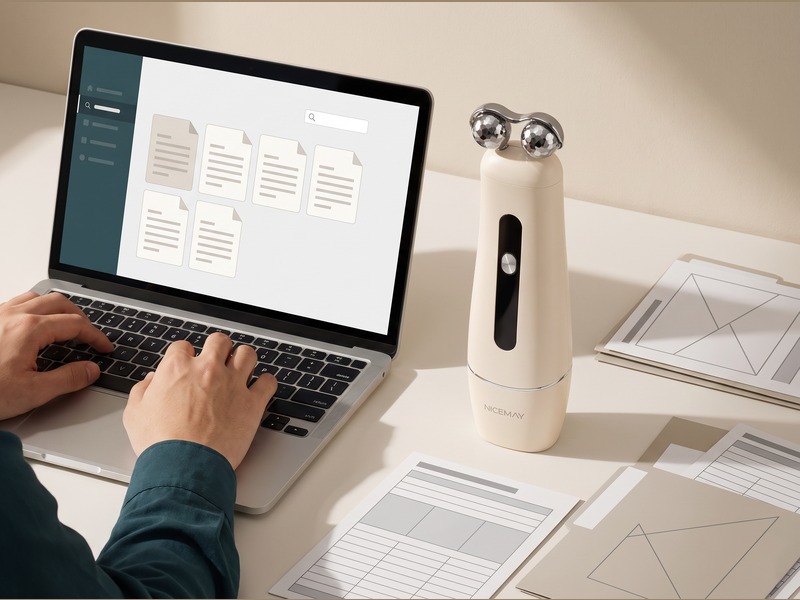
Consider a quality engineer investigating a charging issue. A useful assistant could retrieve the applicable test procedure, identify the relevant product revision, and summarize similar failure reports with links to the original records. It should not invent a new acceptance limit or authorize shipment.
This is a proposed beauty-device workflow, not a claim that a named manufacturer has already deployed it. McKinsey identifies internal search and task automation as beauty-industry applications, while L’Oréal has disclosed substantial enterprise use of generative AI. Neither source establishes widespread deployment in beauty-device factories.
Why It Can Become Commercially Useful Within Two Years
This approach can work with an existing product portfolio. It does not necessarily require a new enclosure, sensor, or manufacturing line. Its usefulness can also be evaluated against specific questions and approved records before it is released to a wider team.
Potential value comes from reducing time spent locating information and preparing drafts. For a software supplier, the commercial model could be an implementation fee and ongoing service contract. For a manufacturer, the return would primarily be operational rather than a new consumer product category. These are possible business models, not reported industry averages.
The main obstacle is document quality. If drawings, test reports, and bills of materials disagree, an assistant can reproduce that disagreement in fluent language. Version control, access permissions, source citations, and an escalation path are therefore part of the product—not optional additions.
For OEM/ODM businesses serving several brands, customer data must also remain isolated. A faster answer has little value if it exposes another client’s design.
2. After-Sales Support and Companion Apps: A Clearer Customer-Facing Entry Point
The next opportunity is an assistant that helps customers understand a device they already own.
The combination is approved product information, a language model, and a limited set of support actions. It could explain cleaning instructions, help identify an accessory, summarize a warranty process, or guide a customer through an approved troubleshooting sequence.
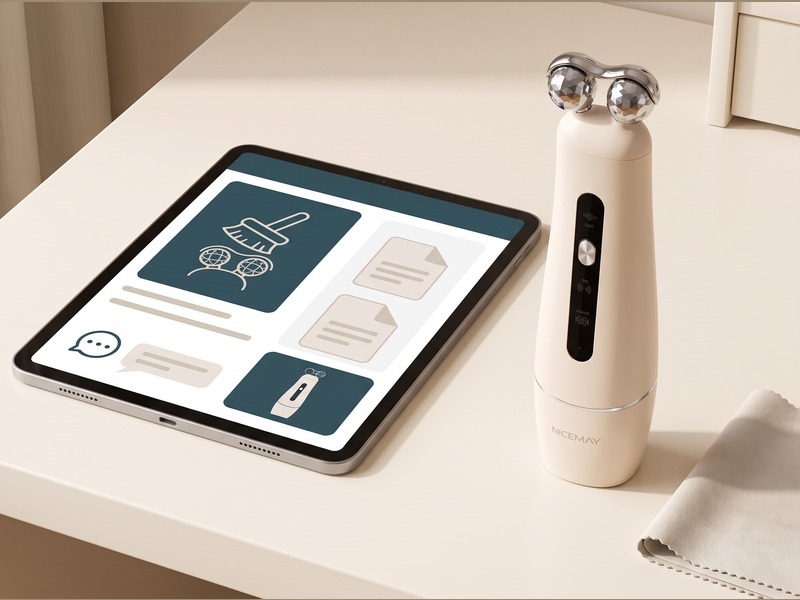
This can be simpler than building a new AI-enabled device. The hardware can remain unchanged while the support experience improves. However, the assistant must know the exact model, market, and instruction revision; advice for a similar-looking device is not necessarily safe or correct.
A companion app can extend this approach by combining validated computer vision with generated explanations. The vision model provides a bounded observation. The language model explains that observation and retrieves relevant guidance. It should not turn an uncertain image result into a diagnosis or a recommendation to exceed the device instructions.
Where the Commercial Value Could Come From
For a brand, the potential benefit is better onboarding, fewer avoidable support contacts, and more consistent product guidance. For an OEM/ODM supplier, a reusable support layer could become an optional part of a connected-device development project.
A subscription is not automatically the right model. Customers may reasonably expect cleaning and safety instructions to be included in the product purchase. A paid service needs value beyond information that should already be accessible.
The evidence also needs careful interpretation. Perfect Corp.’s published technology includes computer-vision skin analysis and diffusion-based digital beauty experiences. That demonstrates a commercial software ecosystem, not a proven generative-AI treatment controller.
This makes a companion app a plausible integration opportunity, but not proof that generated recommendations improve a device’s physical results. Lighting, image quality, and differences between users remain important. A 2025 skin-tone measurement study found substantial limitations in photographic color measurement, reinforcing the need to validate the input rather than merely improve the explanation.
3. Generative Design and CAD: Promising for Prototypes, Not Automatic Production
For companies developing new hardware, generative design is a more direct manufacturing opportunity than a consumer chatbot.
The relevant combination is generative concept creation, editable CAD, design-for-manufacturing checks, and engineering validation. A model might help explore alternative handle shapes or component layouts. Engineers would then assess manufacturability, tolerances, thermal behavior, and usability.
Microsoft Research has demonstrated approaches to generating and editing parametric CAD through projects including FlexCAD, CADFusion, and CAD-Editor. Autodesk has also announced a direction toward neural CAD and generative foundation models for engineering tools.
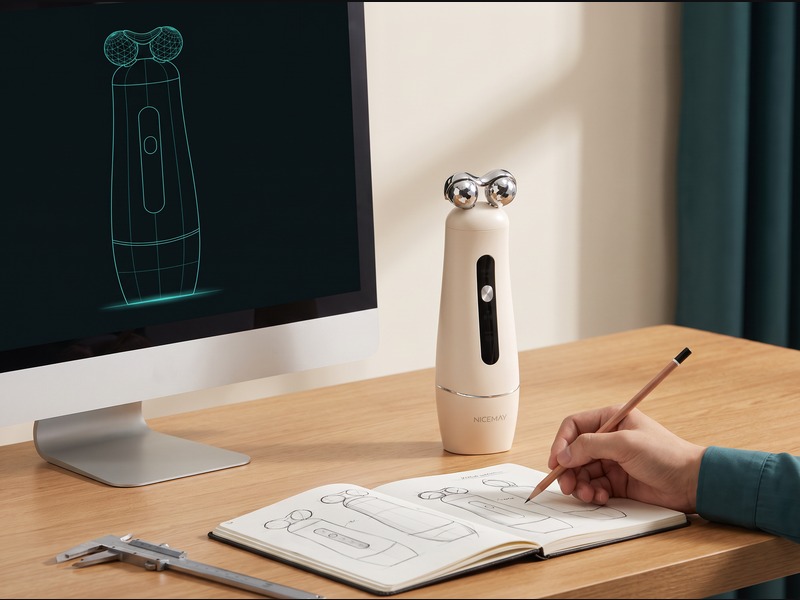
These developments make the workflow credible. They do not establish that beauty-device manufacturers already use it for validated mass-production designs.
What Is Realistic in the Next 24 Months?
The most achievable use is likely to be constrained assistance within an existing design process: exploring concepts, making selected edits, and preparing alternatives for engineering review.
A generated product image is not a manufacturing file. Even an editable CAD model may fail practical checks. A handheld device still needs room for its battery, electronics, seals, fasteners, and treatment head. An LED mask still needs physical evaluation of fit and relevant output characteristics.
A useful commercial result would be fewer unnecessary design iterations or faster review—not simply more concepts. The evaluation should count engineering correction time and rejected designs, rather than only the speed of the first generated output.
This is why AI-assisted development should remain connected to beauty device design and engineering, rather than being presented as a replacement for it.
4. Synthetic Skin Data and Visual Simulation: Commercial Software, Conditional Device Value
Synthetic skin imagery is already a clearer generative-AI application than autonomous beauty treatment.
Haut.AI’s SkinGPT generates visual simulations of skin changes. Microsoft’s customer case describes its commercial launch in January 2025 and its use in a broader skin-analysis and simulation platform.
For device companies, two distinct opportunities follow. Synthetic images may help develop or test software. Visual simulations may also support consumer education. The first is an engineering application; the second is a communication application. They require different validation.
Where the Combination Could Work
A manufacturer developing camera-based features could use generated images to explore selected lighting or appearance conditions, alongside real datasets. The critical test would be whether the resulting system performs better on independent real-world data—not whether the synthetic images look convincing.
Synthetic data cannot establish fairness by itself. A generator may reproduce gaps or bias in the data used to build it. It also cannot replace actual evidence about temperature, optical output, or the safety of energy delivery.
For consumers, an image showing smoother-looking skin is especially sensitive. It can be interpreted as a promised outcome even if it was intended only as an illustration. Unless validated for a particular device and use, it should not be presented as a forecast of that customer’s results.
The near-term business opportunity is therefore strongest in clearly bounded software services. A claim that a simulated image predicts a treatment outcome carries a substantially greater evidence burden.
What L’Oréal and P&G Reveal About the Direction of Travel
The major beauty groups provide useful signals, but their projects should not be compressed into a single story about generative-AI hardware.
L’Oréal’s portfolio connects digital analysis, personalization, and physical devices. Its acquisition of ModiFace was a corporate transaction; its IBM foundation-model project concerns cosmetic formulation; and its NanoEnTek collaboration supports Cell BioPrint. These are different forms of capability building, with different relationships to device manufacturing.
Together, they suggest that the commercial advantage may come from combining domain data with software and hardware expertise. They do not prove that L’Oréal has commercialized autonomous generative control of beauty devices.
P&G’s Opté offers a historical example: imaging, algorithms, and precision dispensing in a physical product. At its launch, P&G Ventures described it as a device developed through its internal startup studio, not as a generative-AI product. Industry reporting in 2023 described the business being wound down, so it should not be treated as evidence of a currently expanding device platform.
Its relevance to the next two years is the technology combination. Perception and precise output can create a differentiated device; adding generated language does not automatically improve that device’s economics or efficacy. The generative component needs its own reason to exist.
Why Autonomous Energy Control Is Not the Leading Two-Year Opportunity
The least convincing near-term proposition is a generative model that freely determines treatment settings from a photograph or conversation.
Device safety depends on physical characteristics and intended use. For energy-based products, actual output, contact conditions, exposure, and protective controls matter. A plausible-sounding recommendation is not evidence that those factors are safe for an individual user.
FDA’s 2025 safety communication on radiofrequency microneedling describes serious complications and emphasizes that it is a medical procedure, not an at-home treatment. That warning concerns RF microneedling specifically; it is not a blanket statement about every home-use RF product. It nevertheless illustrates why invasive and energy-based functions require product-specific evidence.
Generative planning might eventually be tested within tightly constrained systems. But an independent safety controller, approved operating limits, and appropriate validation would still be necessary. Human approval alone cannot compensate for an inadequately validated recommendation.
For near-term projects, a more defensible separation is to let generative AI explain or assist while validated systems govern operation. That boundary should be assessed according to the intended function and claims, not assumed merely because the software is called an assistant.
What Would Count as Commercial Success?
An impressive demo is not enough. Each opportunity needs a measurable benefit and an explicit failure boundary.
For an engineering assistant, useful evidence would include correct retrieval of current documents and reduced review effort, with errors and escalations recorded. For support software, it would include accurate model-specific guidance and appropriate handling of safety questions.
For generative CAD, the relevant outcome is a design that survives engineering review and physical testing. For synthetic data, it is improved performance on real-world validation data. App engagement or attractive simulations cannot substitute for either.
The cost calculation also needs to include integration, evaluation, data maintenance, and model updates. A lower software subscription price is not necessarily a lower total cost. NIST’s generative-AI risk profile treats evaluation and risk management as lifecycle activities, which is a useful frame even where it is not a regulatory requirement.
For a physical product, these activities sit alongside—not instead of—prototype verification and pilot production.
Where Manufacturers Should Place Their Near-Term Attention
For an established OEM/ODM business with usable technical records, a controlled knowledge assistant is the most accessible starting point. For a brand with a connected product and a support burden, approved-information assistance is a plausible next step. For a development team launching new hardware, generative CAD deserves a bounded pilot. Synthetic skin data is a more specialized opportunity that depends on a strong validation capability.
This ordering is an editorial assessment of deployment difficulty, not a measured industry ranking. A company without version-controlled records may find RAG harder than expected. A team already equipped for software validation may find a companion feature easier than a factory integration.
The most credible proposition for the next 24 months is not “AI replaces the engineer” or “AI chooses the treatment.” It is a specific improvement to development, support, or validated personalization, with clear responsibility for the output.
For brands planning a new product, the hardware brief remains the starting point. Explore Nicemay’s home-use beauty device manufacturing options oder discuss a development project, including the intended function, target market, and verification needs. Any proposed generative-AI feature should be scoped and evaluated separately; it should not be assumed to be included in standard manufacturing services.
Literaturverzeichnis
[1] Microsoft customer story: Haut.AI, Azure AI, and SkinGPT commercial deployment
[2] L’Oréal Annual Report 2025: enterprise AI adoption and beauty technology
[3] Microsoft Research: generative and editable parametric CAD
[4] L’Oréal: Perso AI-powered personalized cosmetic dispensing
[5] FDA: aesthetic devices, intended use, and regulatory scope
[6] McKinsey: generative AI applications across the beauty value chain
[7] NVIDIA: Perfect Corp. computer vision and diffusion-based beauty experiences
[8] Prospective-comparative study of skin-tone measurement and dermatologic dataset labeling
[9] Autodesk: generative foundation models and neural CAD direction
[10] L’Oréal: acquisition of ModiFace
[11] IBM and L’Oréal: foundation-model collaboration for cosmetic formulation
[12] L’Oréal: Cell BioPrint and the NanoEnTek technology partnership
[13] P&G Ventures: Opté precision skincare device and internal venture development
[14] FDA: RF microneedling safety communication dated October 15, 2025
[15] NIST: Generative Artificial Intelligence Risk Management Profile
[16] The Business of Fashion: P&G winds down Opté four years after launch