Red Light and LED Light Therapy for Skin: What Should Brands Know?
Consumers want to know whether red light and LED light therapy for skin actually work. Brands face a harder question: which product can turn that interest into a credible, repeatable home-care offering? Two devices can share the same red glow while delivering different spectra, doses and user experiences.
Choosing by LED quantity, color count or a supplier’s strongest claim can leave a brand with specifications it cannot verify and advertising it cannot support. A good-looking sample is a starting point, not a complete product decision.
الإجابة المباشرة: Some home-use red and LED devices may improve selected skin-appearance measures under specific protocols. Brands should match the intended benefit to the finished device, measured output, relevant evidence, safety assessment and market requirements—not assume that every light-emitting product performs equally.1 2 3
This guide is for beauty brands, skincare companies, importers, distributors and private-label teams. It explains the technology before translating it into sourcing decisions. It is not a personal treatment plan or a substitute for medical advice.

What Is Red Light and LED Light Therapy for Skin?
LED means light-emitting diode. A skincare device uses these components to produce selected optical emission bands. A color name describes the visible appearance, whereas a peak wavelength in nanometers identifies where an emission band is strongest. Neither description alone establishes how much light reaches the intended treatment surface.4 5
Red and near-infrared applications are commonly discussed as photobiomodulation, or PBM. In this context, light is studied for interactions with biological processes rather than primarily for removing tissue through thermal injury. Cellular or laboratory findings can explain a research rationale, but they do not establish a finished mask’s cosmetic performance.1 4
Blue-light acne research includes another rationale: interaction with naturally occurring porphyrins in acne-associated bacteria. This should not be confused with clinical photodynamic therapy, which uses a photosensitizing agent together with activating light. Evidence for a drug-and-light procedure cannot simply be borrowed for a home LED device used alone.3 4
Similarly, LED skincare is not interchangeable with UV phototherapy, IPL or laser resurfacing. Some low-level lasers are used for PBM, so the distinction is not simply “LED is gentle and every laser is aggressive.” Buyers need to identify the actual source, operating conditions and intended use. A home facial device should not inherit unrelated medical, wound-care or hair-growth claims.1 4
Do At-Home Red Light and LED Devices Really Work?
The useful answer is device-specific. There are positive findings for selected home-use protocols, but they do not make every red-light mask effective for every concern. The American Academy of Dermatology notes that researchers study different devices, treatment times and questions, making results difficult to compare. Regular use may be needed, responses vary and not everyone sees results.1
A 2026 systematic review of at-home LED facial rejuvenation included eight studies and 365 participants. Its abstract reports improvements in several facial-aging measures, particularly with commonly studied red and near-infrared devices. The authors also identify protocol variation, limited comparative data and underrepresentation of diverse skin phenotypes. This is encouraging category evidence, not verification of a Nicemay model.2
A 2025 systematic review and meta-analysis examined six studies involving 216 participants with mild-to-moderate acne. Selected portable or at-home red and/or blue devices performed better than controls on several outcomes. However, different light sources, doses and treatment durations made comparisons difficult, and the authors caution that findings may not generalize to other products on the market.3
For sourcing, we recommend four practical questions. First, can the actual output be measured and held within an agreed specification? Second, does the evidence support the proposed outcome for this configuration? Third, can intended users follow the evaluated routine? Fourth, can the final claims and labeling be used in the destination market?
A “yes” to only one question is not enough. A laboratory-measured output does not prove wrinkle improvement. A clinical paper does not establish production consistency. A pleasant sample experience does not validate the advertised benefit. These checks work together, rather than substituting for one another.
Define effectiveness before reviewing a supplier’s evidence. “Improves fine-line appearance after the evaluated routine” is a different endpoint from “users find the mask comfortable.” A photograph immediately after use is different from a measured change after several weeks, and neither establishes permanence. Any lasting-benefit claim needs appropriate follow-up rather than an assumption that change continues indefinitely.1 2
Which Skin Appearance Benefits Are Reasonable to Discuss?
Start with a narrowly defined outcome. Red and NIR research is relevant to selected fine-line, texture and other facial-aging measures. Whether a particular product may use those claims depends on the evidence and applicable rules, not simply on having red LEDs. “Appearance of firmness” is not interchangeable with structural lifting or a promise to correct pronounced laxity.1 2
The following is a claim-review framework, not a menu of automatically approved wording. Even qualified phrases need substantiation when used in product advertising.
| Proposed positioning | Evidence to examine | What it does not establish |
|---|---|---|
| Fine-line appearance | Relevant human outcomes and a justified match to the finished configuration | Permanent wrinkle removal or a home facelift |
| Skin texture | Defined measurement method, comparison and evaluated routine | Improvement in every skin concern |
| Appearance of firmness | A specific endpoint rather than an undefined “lifting” impression | Guaranteed structural change or correction of severe laxity |
| Comfortable repeat-use routine | Usability, fit, instruction comprehension and tolerance data | Clinical efficacy |
| Acne-oriented concept | Relevant clinical evidence plus intended-use and regulatory review | Authorization for an unrelated mask to claim acne treatment |
Avoid converting a mechanistic statement into a consumer promise. A study discussing collagen-related activity does not make “regenerates collagen” an established claim for a private-label mask. If the human endpoint was texture, a brand should not present it as proof of facial lifting.2 4
Clinical and commercial outcomes should also stay separate. Wearability, recognizable design and clear controls may help a product fit its channel, but they do not quantify efficacy or guarantee sales. Validate customer acceptance and price positioning separately from optical performance.
How Do Red, Near-Infrared, Blue and Other LED Colors Differ?
Red and NIR are commonly evaluated in facial-rejuvenation research. NIR is outside the visible spectrum: a red glow does not prove that an NIR channel is present or operating correctly. Both need measurable spectral and output information rather than visual confirmation.1 2 5
Blue and blue/red devices have acne-related research. This belongs to a separate intended-use discussion, not an automatic extension of a red-light beauty routine. A blue LED option should be assessed against the actual study protocol and the proposed market claims.3
Yellow or amber findings depend on the exact wavelength and context. A study of one emission band does not validate a nearby band just because both look warm-colored. Green and other secondary modes should not receive confident pigmentation or disease-related benefits from a generic supplier chart.4
Purple, cyan and white may describe combinations or broader emission rather than a single wavelength. Ask what each button activates and how much each channel contributes. Combining emitters does not automatically combine every claimed benefit.4 5
Our supporting guide to LED light therapy colors and benefits explains these color meanings and evidence differences in more detail. Here, the important sourcing principle is that a color menu is not a substitute for a specification.
Which Home-Use LED Format Fits a Brand’s Product Strategy?
Masks, handheld tools and panels solve different design problems. No format is automatically more effective. Compare the exposure it can deliver in the intended routine, then consider how users will wear, hold, position and clean it. Published home-device work shows why geometry and instructions need to be considered with output, although findings from particular handheld products cannot be generalized to all masks.5
| Format | Possible brand role | Verification priority |
|---|---|---|
| Flexible facial mask | Wearable facial-care platform | Fit variation, eye-area geometry, output across curves and material durability |
| Rigid facial mask | Structured format with fixed component locations | Facial clearance, contact pressure, supported positioning and light leakage |
| Handheld local device | Compact targeted-care or bundle item | Working distance, treatment-area guidance and exposure during user movement |
| Panel | Stationary light-care setup | Positioning, area coverage, reproducible distance and exposure to nearby people |

A DTC hero product needs understandable education and a routine worth repeating. An Amazon listing needs consistent claims, clear accessories and instructions that work without a salesperson. Distributors need stable models and documents for their territories. A skincare bundle also needs a justified compatibility plan rather than a blanket statement that every serum improves light delivery.
Use a landed-cost model, not just the ex-factory quote. Include the device, controller, protective accessories, packaging, agreed testing, warranty support and fulfillment costs. A cheaper platform may become expensive if its fit, instructions or specification gaps require redesign.
At Nicemay, our home-use beauty device selection guide provides a starting point for relating a product brief to available categories. A red-light platform should be chosen for the role it can credibly perform, not because light-based products are visually distinctive.10
Which Home-Use LED Specifications Should Buyers Verify?
A quotation lists what a supplier proposes to sell. A controlled specification defines what the finished product must deliver and how conformity will be checked. For a private-label LED device, that difference is central to comparing samples and accepting production.
Spectrum and wavelength tolerances
Request the nominal peak wavelength, spectral bandwidth and allowed variation for every independent channel. Describe mixed modes by their active channels, not only their visible color. A menu with seven colors may use fewer independent emission bands; it therefore needs a channel map rather than seven presumed therapeutic wavelengths.4 11
Spectral width and manufacturing tolerance are different. Width describes the spread of wavelengths in an emission band; a tolerance describes the permitted change in an agreed characteristic. Ask how bandwidth is defined, such as full width at half maximum, and keep that definition separate from a peak-wavelength acceptance limit. A nominal “660 nm” label does not provide either complete description.11
Agree how the spectrum will be measured after the light passes through the final optical components. A component datasheet does not, by itself, describe the complete assembled product. Record the LED part and supplier, relevant binning, driver conditions and any diffuser or protective layer included during testing.
Irradiance at a defined treatment surface
Irradiance is incident optical power per unit area, commonly expressed in mW/cm². It is not the device’s electrical wattage. A useful report identifies the measurement plane, distance, orientation, instrument, calibration status and active mode. A value without these conditions cannot be compared reliably with another supplier’s number.11
For facial masks, define representative measurement locations and the fitted configuration. For panels, specify the supported positioning and distance. For handheld tools, clarify the allowed contact or stand-off condition. Do not automatically apply a point-source inverse-square calculation to a close LED array; geometry and beam overlap require an appropriate measurement method.11
Separate a local peak from an area average, and state how each was obtained. If several wavelengths operate together, request a justified breakdown by channel or band. Otherwise, a quoted total may hide a small contribution from the wavelength central to the product story.
Dose, pulses and session control
Surface radiant exposure, often called fluence, describes incident energy per unit area over time. For constant irradiance, it equals irradiance in W/cm² multiplied by exposure seconds. An illustrative 20 mW/cm² for 600 seconds gives 12 J/cm² at that measurement surface. This is arithmetic, not a recommended dose, an absorbed dermal dose or a Nicemay specification.11
If output varies, calculate exposure from the time-dependent output rather than assuming the start-up value remains constant. For pulsed modes, identify peak and time-averaged values, pulse frequency, pulse duration and duty cycle. A larger peak value does not necessarily mean a larger average exposure, and similar total exposure does not prove that two protocols are biologically equivalent.4 11
Document the session timer, permitted mode changes and what happens after interruption, restart or repeated button presses. Confirm whether intensity settings change all channels together or alter their balance. The marketed “ten-minute routine” must correspond to a controlled operating sequence, not just a label on the box.
Coverage, fit and stability
Ask for mapped output at agreed positions, with a defined method for evaluating variation. One reading at the brightest point cannot describe the entire face. Inspect the intended eye openings, nose clearance and jaw coverage, while distinguishing covered areas from excluded treatment zones.11 6
Specify the operating conditions that will be checked, such as start-up, stabilized output, different battery states and the defined session end. If the product permits operation during charging, include that condition in the assessment; if it does not, the instructions and control behavior should agree. Output stability and temperature should be evaluated together, without treating felt warmth as proof of efficacy.11
The following records belong in the project’s agreed acceptance package. Values and tolerances should be selected from the actual design, evidence and risk assessment—not copied as a universal industry standard.
| العنصر | Measurement or review conditions | Acceptance record |
|---|---|---|
| Spectrum | Each channel and final optical assembly | Peak, bandwidth, tolerance and report revision |
| Irradiance | Defined distance, positions, modes and instrument | Local and average results with allowed variation |
| Exposure | Actual session sequence and time-dependent output | Per-mode, per-band calculation or measurement |
| Pulses and timer | Relevant settings, restarts and interruptions | Waveform/timing record and permitted deviation |
| التغطية | Approved fit and treatment geometry | Output map and defined evaluation method |
| Stability and temperature | Agreed operating and charging conditions | Optical and temperature records over the session |
| Product identity | Final hardware, firmware, controller and accessories | Approved configuration and change-controlled specification |
A sample approval should reference this package. Keep an approved configuration record or reference sample, but do not let visual similarity replace measurements. When units fail an agreed limit, the contract should define quarantine, investigation, corrective action and reinspection rather than accepting an undocumented explanation.
Also agree how measurement uncertainty will be handled near an acceptance limit. Ask whether the instrument and method are suitable for the spectrum, pulse pattern and geometry being measured. A reading from an unsuitable detector can look precise while failing to describe the output correctly. Precision in a spreadsheet is not a substitute for a calibrated, appropriate method.11
How Should Brands Evaluate LED Safety Before Launch?
Safety is a finished-product question. An LED component, a soft mask body or a short session does not establish that every configuration is suitable for every user. The assessment needs the actual spectrum, output, geometry, exposure time and intended operating conditions.1 6
Optical and eye-safety assessment
IEC 62471 provides a framework for evaluating photobiological hazards from lamps and lamp systems, including LEDs. It addresses exposure limits, measurement and classification; it is not a clinical-effectiveness certificate. The testing laboratory should identify the applicable standards, editions and any additional requirements for the model and market.6
For a mask, examine normal wear, foreseeable displacement, direct viewing and light leakage around eye openings. If protective accessories are used, their performance and fit need to be assessed with the device. A silicone surround or a photograph of closed eyes is not, by itself, evidence that the required protection has been achieved.6
The AAD advises using the eye protection specified by the device instructions and not substituting sunglasses for required goggles. Brands should translate the assessed protection into clear instructions and included accessories. They should not rely on a customer to infer the precautions from a lifestyle image.1
Electrical, thermal and material review
Build a risk-based test plan covering the power system, battery, charger, accessible temperatures, controller, mechanical durability and skin-contact materials. Assess cleaning exposure, flexing, connectors and foreseeable misuse for the chosen format. Where a water-resistance rating is claimed, verify the rating and keep it consistent with the cleaning instructions.
These are procurement priorities, not a declaration that one checklist satisfies all legal requirements. A report for a different charger, material or controller may not describe the version being sold. Check model identifiers, sample configuration, test methods and any conditions attached to a pass result.
Suitability and instructions
The AAD highlights light-sensitive conditions, relevant medicines and pigmentation concerns for darker skin tones. Long-term safety and optimal treatment schedules remain questions, while individual responses can vary. Product teams should ensure that warnings, exclusions and escalation instructions are supported by qualified review, rather than claiming “safe for everyone.”1
Instructions should explain permitted use, session limits, protective accessories, cleaning and what to do if discomfort or visual symptoms occur. Do not turn a published study’s schedule into universal consumer advice. A useful manual describes the evaluated finished device and should be understandable without a technical representative present.1
How Can Brands Validate Claims and Market Readiness?
Keep five evidence categories separate: optical characterization, human performance data, usability feedback, safety evaluation and regulatory documentation. Each answers a different question. A report showing output conformity cannot replace human outcome evidence; regulatory terminology cannot replace a report for the actual model.
When assessing human data, review the full protocol: participants, skin characteristics, comparison, final configuration, use schedule, endpoints, statistical analysis, adverse events and follow-up. Determine whether the outcome was measured objectively, rated by investigators or reported by users. These approaches have different limitations, which should stay beside the claim.2 3
Before commissioning a study, involve an appropriately qualified team and address ethics, consent and local requirements. Define how the tested configuration will relate to the commercial product. An unsupported assumption that “the wavelength is close enough” is not an adequate bridge between a paper and an advertisement.
In the United States, establishment registration and device listing do not mean FDA approval, clearance or authorization. Verify any claimed market status against the actual device and intended use. Do not use “FDA certified” or a third-party registration certificate as a substitute for that check.7
For Europe, the United Kingdom, Australia, Japan and South Korea, establish the relevant classification and responsibilities with qualified local support. “Beauty device” is not a universal exemption, and electrical or EMC paperwork is not evidence of clinical efficacy. Avoid assuming that a document accepted in one territory authorizes the same claims everywhere.
Customization needs a documented impact assessment. Changing emitters, driver output, firmware, session length, optics or eye geometry may change the evidence match or safety profile. For devices within the FDA 510(k) framework, official guidance explains when modifications may require a new submission. That guidance is not a statement that every cosmetic LED product requires a 510(k).8
Finally, align packaging, instructions, website copy, social advertising and distributor materials. If only one evaluated mode supports the proposed benefit, do not imply that every intensity and color provides it. Claim control should continue after launch when configurations, partners or sales territories change.
What Should Buyers Ask an LED Beauty Device OEM/ODM Manufacturer?
Start with a commercial brief that engineering can evaluate: target market, customer group, main cosmetic positioning, format, channel, price range and expected quantity. Then decide which features are essential and which need evidence before they belong in the product story.
At Nicemay, we use a platform-and-project discussion rather than assuming every client needs the same configuration. Our LED OEM/ODM and private-label platforms provide a starting point; the final scope should be agreed against your brief, sample evaluation and verification needs.9 10
For example, our published MR-2308 LED mask configuration lists 605 nm amber, 630 nm red, 660 nm deep red and 850 nm NIR, alongside wearable design and control features. These are published platform details, not independent efficacy verification or a guarantee of complete eye protection. Blue is not listed in that configuration.9
Branding and packaging can be discussed alongside deeper changes to the design, PCBA and mode structure. Our design and engineering support should be considered with the project’s validation scope: a new look can affect fit or optics, and a new controller can affect operation. Confirm feasibility, responsibilities and retesting before freezing the specification.9 10
Use the following supplier checklist during sampling and contract review. It describes questions to resolve, not certifications that every supplier or Nicemay model already holds.
- Can you provide the final spectrum, mode-specific output, measurement conditions and tolerances?
- Do safety and performance documents identify the actual hardware, firmware and accessories?
- Which checks are performed at incoming, in-process, final and outgoing quality stages?
- How are instruments calibrated, lots traced and unexpected results investigated?
- Which changes require client approval, retesting or updated market documents?
- What records connect the approved sample to the pilot run and repeat orders?
- How are complaints, corrective actions, warranty support and replacement parts handled?
Our beauty device verification process describes design validation, testing and pilot-production stages. Agree the model-specific test plan rather than assuming a general services page proves every measurement has already been completed. Before الإنتاج الضخم, confirm inspection criteria, critical-defect handling and change control.10
Separate design validation from routine production screening. Incoming quality control, or IQC, might check approved component identities; in-process quality control, or IPQC, might monitor assembly and connection quality. Final and outgoing quality control, FQC and OQC, should follow the agreed release plan. These stages are proposed controls to discuss, not a claim that every optical test is performed on every unit.
Define which checks are unit-level, lot-based or periodic, how samples are selected and what triggers expanded inspection. An indicator-light check may confirm that a channel turns on, but it cannot replace quantitative NIR verification. Record any aging or reliability test conditions, duration and pass criteria rather than accepting the word “tested” without a method.
Finally, define ownership of the specification, packaging files and approved changes. For repeat orders, require confirmation that the same controlled configuration is being supplied, or a documented review of differences. The goal is not simply to receive a successful first sample, but to know what will be shipped months later.
MOQ, lead time and cost depend on the chosen platform, customization and verification scope. A stable launch plan should include these activities rather than only the assembly schedule. Share your target market, retail price, channel and intended LED positioning with Nicemay to discuss an appropriate platform and the checks needed before commitment.
What Should B2B Buyers Remember?
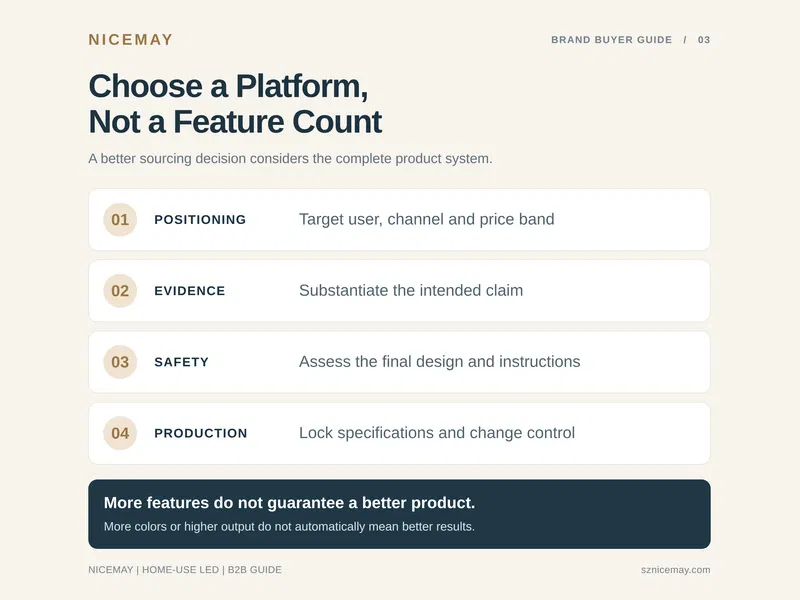
The strongest LED platform is not the one with the most colors or the largest output claim. It combines clear positioning, measurable specifications, appropriate safety, supportable benefits and repeatable manufacturing. Choose the whole product system, not a wavelength label.
What Else Should Buyers Know About Home-Use LED Therapy?
Does red light therapy for skin really work at home?
Some studied devices and protocols show improvements in selected appearance measures. Results vary, and evidence for one product does not prove another. Match the intended benefit to the finished configuration, output, evaluated routine and supporting data.1 2
Is near-infrared the same as red LED light?
No. Near-infrared is outside the visible spectrum and needs separate identification and measurement. A visible red glow does not establish NIR output or dose. Request channel-specific information for a combined product.1 5
Are more colors or more LEDs always better?
No. Several color settings can share emitters, and LED count does not establish spectrum, delivered exposure or uniformity. Compare the measured configuration and evidence for the intended outcome instead of ranking feature counts.4 5
What specifications should a private-label LED mask supplier provide?
Request spectrum, per-mode output, measurement conditions, coverage, timing, pulse information where relevant, tolerances and final product identity. The accepted specification should link the approved sample to production and the labeling supplied with it.
Does FDA registration mean an LED device is cleared?
No. FDA establishment registration and device listing do not denote approval, clearance or authorization. Verify the actual status and intended use instead of relying on a registration certificate.7
Can brands customize wavelengths or treatment modes?
That depends on platform feasibility and project scope. Changes may affect optics, output, safety, instructions and claim support. Agree an impact assessment and the needed verification before treating a customized sample as ready for sale.8 9
How should brands define use frequency and cleaning?
Use the evaluated protocol and material-compatible instructions for the finished device. Do not copy a generic schedule or cleaning solvent from another mask. Confirm instruction comprehension and cleaning compatibility before launch.1
Can one device claim cosmetic benefits and acne treatment?
Do not assume it can. Each intended use needs appropriate evidence and market review. A red-light platform without a validated acne-oriented configuration should not inherit treatment claims from studies of different devices.3 7
المراجع
[1] American Academy of Dermatology: Is red light therapy right for your skin?
Return to text: 1 · 2 · 3 · 4 · 5 · 6 · 7 · 8 · 9 · 10 · 11 · 12 · 13 · 14
[2] Das et al. 2026: At-home LED facial-rejuvenation systematic review; abstract accessed
Return to text: 1 · 2 · 3 · 4 · 5 · 6 · 7 · 8
[3] Ershadi and Barbieri 2025: At-home LED devices for acne, systematic review and meta-analysis
Return to text: 1 · 2 · 3 · 4 · 5 · 6
Return to text: 1 · 2 · 3 · 4 · 5 · 6 · 7 · 8 · 9 · 10
Return to text: 1 · 2 · 3 · 4 · 5 · 6
[6] IEC 62471:2006: Photobiological safety of lamps and lamp systems
[7] U.S. FDA: Important Reminders about Registration and Listing
[8] U.S. FDA: Deciding When to Submit a 510k for a Change to an Existing Device
[9] Nicemay MR-2308: Published LED configuration and customization options
[10] Nicemay: Product selection and agreed sample-to-production workflow