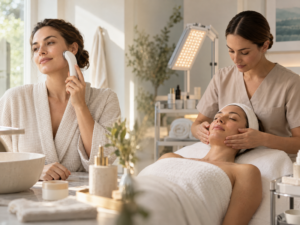
Consumers ask the same questions every day: What is the best home device for sagging skin? Do at-home skin tightening devices really work? Is there a skin tightener that actually works? For a beauty brand, importer, distributor or private-label seller, these questions create a more difficult product decision. RF, EMS, microcurrent, LED and multi-function devices may all use the language of lifting or firming, but their mechanisms, outputs, user experience, evidence and regulatory boundaries are not interchangeable.
Some non-invasive home beauty devices may support defined cosmetic goals, such as the appearance of firmness, facial toning or skin texture. However, results depend on the finished device, its controlled output, the use protocol, user consistency. The best device is not automatically the most powerful or the one with the most modes.[1]
This article is written for B2B buyers. It explains how to select a home skin tightening device that fits a target customer, price architecture and channel while remaining technically auditable, commercially understandable and practical to develop through OEM/ODM manufacturing.

What Does “Sagging Skin” Mean in a Home-Beauty Context?
“Sagging skin” is a consumer expression rather than a single engineering specification. It may describe reduced-looking firmness, changes in facial contours, fine lines, loss of elasticity, temporary puffiness or a general impression that the face looks less defined. Visible facial aging involves the skin barrier, epidermis, dermis, connective tissue, fat compartments and facial movement. A home beauty device should not be marketed as though it can guarantee a particular effect at a particular tissue depth.
For product development, it is more useful to translate the consumer concern into a defined cosmetic routine. A routine might focus on a warming sensation, a massage-assisted skincare application, a facial toning experience, a light-care habit or a temporary refreshed appearance. These are different experiences from a structural or medical procedure. The product brief, instructions for use and marketing claims should make that distinction clear.
A user may perceive several things as “tightening”: warmth during an RF session, a temporary visual change after massage, a sensation of muscle stimulation, improved glide when a conductive gel is used, or a more consistent skincare ritual. These experiences may be commercially valuable, but they should not be presented as proof of permanent lifting, guaranteed collagen remodeling or treatment of skin laxity.
For brands, this distinction is important because it controls the entire product system. If the intended story is a controlled warmth routine, the engineering brief should prioritize temperature management, contact detection, motion and timer controls, gel compatibility and comfort. If the intended story is a portable facial toning routine, the brief should prioritize electrode contact, output consistency, ergonomics, session length and user guidance. The consumer story and the specification sheet must support each other.
Do At-Home Skin Tightening Devices Really Work?
The most accurate B2B answer is neither an unconditional yes nor an unconditional no. Some home devices can support measurable or observable cosmetic outcomes, but the answer is device-specific. A study on one finished RF product does not prove that every RF device has the same output or user result. A product listing that names a technology does not prove that the output is stable, safe or appropriate for a particular claim.
A practical buyer should evaluate effectiveness through four layers.
1. Is the actual output controlled?
A technology name is only a starting point. RF needs a defined frequency, electrode configuration, temperature behavior and cut-off logic. LED needs wavelength, bandwidth, irradiance, energy density, treatment distance and coverage. EMS needs a defined current, waveform, frequency, pulse width and duty cycle. Microcurrent requires output verification under a realistic skin load, not only an open-circuit reading.
If a supplier cannot explain how the output is measured and what tolerance is allowed, the buyer cannot reliably connect the product to a claim, a use protocol or a quality standard.
2. Does the finished product have matching evidence?
The strongest evidence is connected to the same product configuration that will be sold. Buyers should ask whether the tested device has the same hardware, firmware, electrodes, battery, charger, accessories, conductive medium and treatment settings as the production version. They should also review the study design, sample size, comparator, duration, endpoints, adherence and adverse events. Before-and-after photographs alone are not enough.
A 2024 review of home facial rejuvenation devices identified potential benefits across selected studies but also highlighted limited research, small samples and short follow-up periods.[1] A randomized split-face study of a specific home RF device used a defined 1 MHz bipolar system, red light, a gel, temperature control and a motion sensor. The study is useful evidence for that product configuration, not a universal license for every RF product.[2]
3. Can users follow the routine safely and consistently?
A technically capable device can still fail commercially if it is uncomfortable, difficult to clean, hard to charge, time-consuming or confusing. Consistency is part of the product proposition. A clear timer, comfortable contact, understandable intensity steps, suitable accessories and realistic session length may matter more than adding another mode.
Brands should also consider foreseeable misuse. Examples include holding an RF head in one place, using an electrical mode without suitable contact, placing light too close to the eyes, using an incompatible product as a conductive medium or applying an energy device to compromised skin. These use cases should be addressed in risk analysis, instructions and customer support.
4. Are the claims appropriate for the target market?
“Effective” is not a free-standing marketing word. It must be connected to a defined cosmetic endpoint and a permitted claim. A product may be positioned around the appearance of firmness, facial toning, skin texture, warmth, massage or light care. Claims such as permanently lifting skin, reversing aging, dissolving fat, treating disease or replacing a medical procedure require a separate regulatory and evidence analysis and should not be assumed for a home beauty device.
The same discipline applies to certification language. For example, FDA clearance, where applicable, is not a general substitute for product-level efficacy evidence. A company should not use “FDA approved” or “FDA certified” as loose promotional language.[3]
Which At-Home Skin Tightening Technologies Are Most Relevant?
There is no single technology that is best for every brand. The right choice depends on the consumer routine, target retail tier, channel, product form, evidence strategy and manufacturing controls.
| التكنولوجيا | Consumer routine positioning | Key specifications to verify | Commercial strength | Primary risk or limitation |
|---|---|---|---|---|
| Non-invasive surface RF | Controlled warmth and appearance-focused firming routine | Frequency, electrode geometry, skin-load output, temperature limit, contact sensing, motion detection, timer, cut-off and gel compatibility | Strong premium story and clear sensory experience | Heat management, claims discipline and confusion with RF microneedling |
| EMS | Dynamic facial stimulation or toning routine | Current, waveform, frequency, pulse width, duty cycle, electrode contact, use area and comfort | Demonstrable sensation and portable formats | User sensitivity, inconsistent contact and electrical-safety/label review |
| التيار الصغير | Gentle, targeted facial toning and skincare routine | Output under skin load, polarity, electrode material, conductive medium, contact stability and comfort | Quiet, compact and suitable for daily ritual positioning | Fine user perception and product-specific evidence |
| LED | Light-care routine for tone, texture or long-term skincare habit | Wavelength, bandwidth, irradiance, energy density, distance, coverage, thermal rise, timer and eye protection | Visual, content-friendly and easy to combine with skincare | LED count is not dose; long-term evidence and photobiological safety need review |
| Ultrasound | Separate ultrasound-based skincare or professional-adjacent concept | Frequency, output, coupling, contact, thermal behavior, use restrictions and classification | Can differentiate a product line when properly controlled | Different energy and risk context; should not be a default firming claim |
Is RF a practical platform for a home skin tightening device?
Non-invasive surface RF is often considered for premium home beauty products because warmth is easy for users to understand and can be integrated into a structured skincare ritual. In a responsible product brief, the priority is controlled and repeatable thermal behavior rather than the largest power figure.
A buyer should ask for RF frequency, electrode arrangement, output under skin or representative load, temperature range, upper limit, contact sensing, motion or stationary detection, timer behavior, automatic reduction, emergency cut-off and conductive-medium compatibility. The product should also be evaluated for comfort, hot spots, treatment-area guidance and foreseeable misuse.
Non-invasive surface RF must be clearly separated from RF microneedling. RF microneedling uses needles to deliver energy into the skin and belongs to a different risk and regulatory context. The FDA states that microneedling devices may reach living tissue, nerves and blood vessels, and it has not authorized microneedling medical devices for over-the-counter sale in the United States.[4] A standard home RF device must not borrow RF microneedling’s clinical language.
What should brands verify in an EMS facial toning device?
EMS uses electrical pulses to stimulate tissue. For a home beauty product, the market position may be facial stimulation or temporary cosmetic appearance support, subject to the finished device and the target market’s review. Buyers should not accept “EMS” as a sufficient specification.
The technical file should identify current range, waveform, frequency, pulse width, duty cycle, channel behavior, electrode material, contact quality, intensity steps, treatment areas and shut-off behavior. It should also address user comfort, contraindication language, cleaning, skin-contact materials and the relationship between the supplied electrode configuration and the tested output. FDA guidance for powered muscle stimulators emphasizes the importance of using the recommended leads and electrodes and matching labeling to the intended use.[5]
How is microcurrent different from EMS?
Microcurrent and EMS should not be treated as interchangeable labels. They may differ in output magnitude, waveform, sensation, electrode design and consumer expectation. A microcurrent product may be positioned as a gentle, targeted facial toning routine, but its evidence is often highly specific to the actual product and protocol.
A buyer should request output data under realistic skin-load conditions, polarity information, electrode material and dimensions, conductive-medium requirements, contact stability and comfort testing. If the device has multiple modes, each mode should be separately described, measured and reflected in the instructions. “Microcurrent” should not be used as a substitute for a missing output specification.
Can LED support a skin-care device line?
LED can support a light-care product line, but it should not automatically be called a skin-tightening solution. Depending on the finished product and evidence, a brand may use more cautious language around appearance, tone, texture, glow or a consistent skincare habit.
The key specifications are wavelength, spectral bandwidth, irradiance, energy density, treatment distance, coverage uniformity, thermal rise, timer, eye protection and photobiological safety. LED quantity alone is not a dose. IEC 62471 provides a framework for evaluating photobiological safety of lamps and lamp systems, including LEDs, but safety assessment is not the same as proof of cosmetic efficacy.[6]
The American Academy of Dermatology notes that at-home red-light devices may produce subtle to noticeable results for some signs of aging, but users need regular follow-up use, not a one-time treatment. It also notes that long-term effects are not fully known and that “FDA cleared” does not tell a buyer how effective a device is.[3]
When should ultrasound remain a boundary technology?
Ultrasound should be handled as a separate technical and regulatory workstream. It requires suitable contact, coupling, output control and thermal analysis. FDA materials describe ultrasound procedures as requiring complete contact and note potential risks including burns and nerve damage in relevant applications.[7]
For this reason, a brand should not use RF or LED evidence to support an ultrasound claim. If ultrasound is included in a multi-function device, the mode should have its own specification, validation, instructions, risk controls and market review.
What Is the Best At-Home Skin Tightening Device for a Brand to Source?
For a B2B buyer, the best device is the one that fits the brand’s commercial system. A premium anti-aging brand, an Amazon seller, a skincare company and a distributor may all need different products even if they use the same word—firming.
| Brand objective | Technology direction to assess | Key specifications | Suitable channel | Claim boundary | OEM/ODM challenge |
|---|---|---|---|---|---|
| Premium anti-aging beauty ritual | Controlled RF, optionally paired with a clearly defined light or massage mode | Thermal control, contact sensing, gel compatibility, finish and accessories | Premium DTC, specialty beauty, professional retail | Appearance of firmness, warmth and texture care | Thermal consistency, validation and premium UX |
| Portable facial toning routine | Microcurrent or EMS | Skin-load output, electrode fit, comfort, battery and session control | Amazon, DTC, gifting | Facial toning and refreshed appearance | Contact consistency and user education |
| DTC social-commerce hero product | LED, massage or carefully controlled combination platform | Visible mode feedback, dose data, timer and content-friendly UX | DTC and social commerce | Light care, massage and appearance-focused routine | Avoiding feature overload and unsupported claims |
| Skincare-and-device bundle | RF or microcurrent with a compatible gel or skincare product | Material compatibility, dispensing, stability, packaging and instructions | Skincare brands and bundles | Supports a skincare ritual; no automatic absorption or treatment claim | Coordinating device and cosmetic documentation |
| Giftable entry-level device | One clear mode with simple controls | BOM, charging, durability, cleaning and instruction clarity | Gift sets, retail and seasonal campaigns | Simple cosmetic routine and appearance support | Cost control without weakening safety or reliability |
Nicemay’s face-lifting device manufacturer page illustrates this platform approach. The listed range includes compact microcurrent and LED concepts such as MR-2622 and MR-2623, an EMS/LED/thermal massage platform such as MR-2368, a heated microcurrent LED gua sha concept such as MR-2610, and more advanced RF/EMS combinations such as MR-2121 and MR-2590.[8] These examples are useful for discussing product architecture and private-label fit. They should not be treated as universal recommendations or automatic proof of clinical efficacy.
The same page also presents a product ladder from entry premium to premium flagship, with different treatment areas, channel suggestions and customization routes. That is the right way to think about “best”: not as a universal ranking, but as a product-market fit decision. A three-SKU range may be more commercially useful than one overloaded device if each SKU has a clear role, price point, routine and evidence file.
Combination products can raise perceived value, but every mode adds responsibility. If a device combines RF, EMS, LED, vibration and microcurrent, each mode should have its own output definition, test method, safety control, instructions and permitted claims. A display or a larger mode count does not remove the need for validation.
Which Specifications Separate a Credible Device From a Generic One?
A supplier quotation is not a controlled specification. Before tooling or mass production, the buyer should freeze the product identity and define how the critical parameters will be measured. The specification should identify the exact model, firmware, battery, charger, accessories, materials, treatment modes, tolerances and test conditions.
RF specification checklist
- Frequency and RF configuration, such as bipolar or multipolar, where applicable.
- Electrode geometry, treatment-head dimensions and contact area.
- Output behavior under a defined representative skin load.
- Operating temperature range, maximum temperature and temperature-control method.
- Contact detection, movement detection, timer and automatic reduction or shut-off.
- Conductive gel or medium compatibility, including material and skin-contact assessment.
- Hot-spot testing, abnormal-use testing, charging-state behavior and recovery after cut-off.
EMS and microcurrent specification checklist
- Current range and measurement conditions.
- Waveform, frequency, pulse width, duty cycle and channel configuration.
- Electrode material, size, spacing and contact behavior.
- Intensity steps, ramp-up, ramp-down and mode transition behavior.
- Output under realistic skin-load conditions, not only open circuit.
- Compatibility with the supplied conductive medium.
- Comfort testing, cleaning requirements, use areas and contraindication language.
LED specification checklist
- Nominal wavelength and spectral bandwidth for every light mode.
- Irradiance and energy density at the specified treatment distance.
- Coverage uniformity across the treatment area.
- Thermal rise at the skin-facing surface and session duration.
- Timer, eye protection and light-leakage controls.
- Photobiological safety assessment appropriate to the final assembly.
- LED lifetime, binning or consistency controls and replacement policy where relevant.
Product-system controls
A credible program should also document electrical safety, EMC, charger and battery safety, mechanical durability, skin-contact materials, ingress claims, software and firmware change control, calibration, traceability, complaint handling and corrective action. The exact standards and market documents depend on the product’s intended use and target market. A factory should not promise a universal certification package before the model and claims are defined.
A sample proves that a supplier can make one working unit. A controlled production system proves that the approved unit can be repeated. Buyers should therefore review IQC, IPQC, FQC, OQC, calibration, batch records, approved-component controls and the process for handling engineering changes.
How Should Brands Validate Claims, Safety and Market Readiness?
Market readiness is not one certificate. It is the alignment of product design, output data, risk controls, evidence, labeling, advertising and after-sales support.
Engineering and safety validation
At minimum, the project should consider electrical safety, EMC, charging and battery behavior, over-temperature protection, mechanical durability, skin-contact materials, cleaning, foreseeable misuse, software changes and any waterproof or ingress claim. RF and ultrasound need particular attention to thermal behavior and contact. LED needs light and eye-safety review. EMS and microcurrent need electrical output, electrode and user-contact review.
Human or user evidence
If the brand intends to make a performance claim, the evidence should match the exact device, mode, protocol and target population. Review the sample size, comparator, inclusion and exclusion criteria, skin types, treatment period, adherence, endpoints, measurement tools, statistics, follow-up and adverse events. If the study uses a different gel, firmware or hardware revision, the relevance should be explained rather than assumed.
A well-designed product may be commercially credible without claiming a medical outcome. A careful claims ladder might begin with “designed for a facial toning routine,” “supports the appearance of firmness,” “warming care for a skincare ritual” or “light-based care for a consistent at-home routine.” The final language must be reviewed for the intended market.
Documentation consistency
The product page, packaging, IFU, quick-start card, Amazon listing, advertising, influencer script and customer-service training should not make conflicting claims. A controlled technical file is weakened when a marketplace page promises permanent lifting or treatment of a condition that the approved product documents do not support.
Nicemay’s face-lifting manufacturing page describes a practical sequence: share the project brief, select and customize a sample, confirm the production and quality standard, then inspect, document and ship.[8] For a buyer, that sequence is useful because it creates decision points before mass production. The commercial brief should specify the target market, retail price, expected quantity, preferred technologies, packaging direction, claim language and delivery plan.
What Should a Brand Ask an OEM/ODM Manufacturer?
Before selecting a skin tightening device manufacturer, ask questions that reveal whether the company can manage a product platform rather than only apply a logo.
- Can you explain the output mechanism and boundary of every mode? The answer should cover what the mode is designed to do, where it may be used, where it should not be used and how it is measured.
- Can you provide a controlled specification with tolerances? Ask for test conditions, instruments, acceptance limits and the relationship between the specification and the production inspection plan.
- Do the test reports match the final model? Verify hardware, firmware, battery, charger, accessories, materials and packaging configuration.
- How are engineering changes controlled? Ask how the supplier manages component substitutions, software revisions, tooling changes and revalidation.
- What are the IQC, IPQC, FQC and OQC controls? Ask about incoming materials, in-process inspection, final function testing, charging tests, cosmetic inspection and shipment release.
- How are batches traced and complaints handled? A credible supplier should have a process for batch records, nonconformity, corrective action and customer feedback.
- What support is available for target-market documentation? Discuss labels, IFU, test reports, declarations, packaging, claims review and any market-specific pathway before advertising is finalized.
- Can the platform support meaningful customization? Discuss color, logo treatment, finish, charging accessories, gift box, manual, retail inserts, housing details, interface requirements and function configuration.
- How will the sample be approved? Freeze the approved appearance, function, accessories, firmware, packaging, inspection standard and claim language before the production run.
- Can you support a product ladder? A brand may need a compact entry model, a core premium device and a flagship platform rather than one feature-heavy SKU.
At Nicemay, we help brands translate a commercial brief into a configurable home beauty device project. Depending on the selected platform, this can include product selection, industrial design direction, color and logo treatment, packaging, mode planning, prototype review, specification freeze, production inspection and delivery coordination. Our face-lifting device manufacturer page is intended to help buyers compare platform types and start a focused discussion around target market, retail price, launch channel and preferred technology.[8]
We do not treat a product page as a substitute for product-specific validation. The appropriate output, documentation, testing and claims depend on the selected model, configuration and target market. That is why a serious OEM/ODM discussion should begin with the brief and finish with an approved production standard.
What Should B2B Buyers Remember?
The best home skin tightening device is not the one with the strongest claim or the most modes. It is the platform that combines a clear consumer need, controlled output, appropriate safety design, supportable claims and reliable OEM/ODM manufacturing into a repeatable commercial product.
What Do Buyers Still Ask About Home Skin Tightening Devices?
Do at-home skin tightening devices really work?
Some finished home devices may support defined cosmetic outcomes, but results are product-specific and depend on output, protocol, consistency, evidence and claims. Buyers should evaluate the final model rather than generalize from a technology name or another brand’s study.
What is the best home device for sagging skin?
For a B2B buyer, the best device depends on the target user, channel, price tier, routine and permitted claim. RF, EMS, microcurrent and LED can serve different roles. A platform with clear specifications and a repeatable manufacturing plan is more valuable than a device selected only because it has the highest mode count.
Is RF better than microcurrent for a home skin tightening device?
Neither is universally better. RF may fit a controlled warmth and premium facial-care story, while microcurrent may fit a gentle, portable toning routine. Compare the finished output, contact design, comfort, evidence, claims, safety controls and target-market requirements.
Can a home beauty device combine RF, EMS, LED and microcurrent?
It can be technically possible, but combination is not automatically better. Each mode requires independent output specifications, testing, safety controls, instructions and claim review. The product should remain understandable to users and manageable for quality control.
What specifications should brands verify before sourcing an RF skin tightening device?
Verify frequency, electrode geometry, output under representative skin load, temperature range and limit, contact and motion sensing, timer, automatic reduction or cut-off, conductive-medium compatibility, hot-spot testing, charger and battery behavior, final firmware and production tolerances.
What should brands ask a skin tightening device OEM/ODM manufacturer?
Ask how the supplier manages product selection, engineering, customization, sample approval, specification freeze, IQC/IPQC/FQC/OQC, calibration, traceability, change control, target-market documents, packaging, claims review and mass-production consistency. Also ask which statements are supported by the final model rather than by a general technology description.
الخلاصة
For B2B buyers, a credible home skin tightening device is not defined by maximum power or maximum features. It is defined by product-market fit, auditable output, appropriate safety controls, supportable cosmetic claims and a manufacturer that can repeat the approved specification at scale.
WordPress footnote references
- Bu et al., “Development of Home Beauty Devices for Facial Rejuvenation: Establishment of Efficacy Evaluation System” — supports the limits of current home-device evidence and the need for device-specific evaluation. ↩ Return to text
- Shu et al., “Effectiveness of a Radiofrequency Device for Rejuvenation of Aged Skin at Home: A Randomized Split-Face Clinical Trial” — supports the importance of exact device configuration, protocol and controls. ↩ Return to text
- American Academy of Dermatology, “Is red light therapy right for your skin?” — supports cautious wording for at-home red light, regular use and the distinction between FDA clearance and efficacy. ↩ Return to text
- U.S. FDA, “Microneedling Devices: Getting to the Point on Benefits, Risks and Safety” — supports the distinction between microneedling/RF microneedling and non-invasive surface RF. ↩ Return to text
- U.S. FDA, “Guidance Document for Powered Muscle Stimulator 510(k)s” — supports review of electrodes, leads, intended use and labeling for electrical stimulation products. ↩ Return to text
- IEC 62471:2006, “Photobiological safety of lamps and lamp systems” — supports the LED photobiological-safety evaluation framework. ↩ Return to text
- U.S. FDA, “Non-Invasive Body Contouring Technologies” — supports separate risk review for RF, ultrasound and light-based energy. ↩ Return to text
- Nicemay, “Face Lifting Device Manufacturer” — supports the product-platform, customization and manufacturing-process examples used in the B2B section. ↩ Return to text